Also by Mabel Oaks see: Phelpstown Footprints
The following document was sent to me with the suggestion
that I add it to this site. That was some time ago.
I have forgotten who sent it and am not sure if it was
the owner. Thus I have attempted to locate the owner
for the purpose of gaining permission to post it. My
efforts have not born fruit. There is no longer a Wilson
Press in Phelps, NY. There is one in Waterloo, but
they don't appear to know about the story.
Therefore I am displaying the paper in hopes
that if someone owns the copyright, that they will
contact me.
It is a very well written paper and details
the history of the small church on the
Pre-emption Road in the Hamlet of
Oaks Corners. It was by Mabel E. Oaks
who was in a very good position to Write it.
I recently communicated with the son of Mabel
Oaks who lives in Oaks Corners.
It is good to know there is still an Oaks living there.
If You are
interested in Oaks Corners I am sure you will want to own a copy of
these books. They can be purchased at Phelps Community Historical Society, 66 Main
Street, Phelps, NY 14532. tel 315.548.94940 Summer hours -
May-Aug
Wed- Sat 10 AM-4 PM. Winter (Sept-April) Tues-Fri 10 AM-4
PM. They are
also available by appointment.
The website: http://www.phelpsny.com/phelps-fun/historical-society/
email histsoc@fltg.net

=====================================================================================================
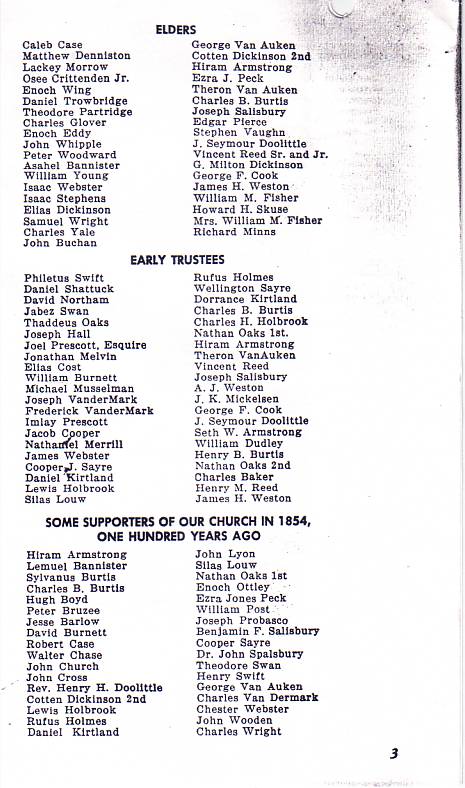
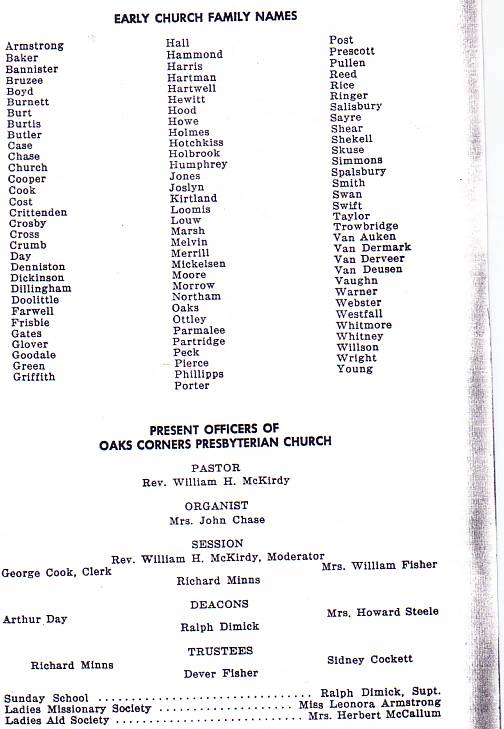
Oral History of Oaks Corners Church and Community
Presented August 1, 1954 by Mabel E. Oaks On the
occasion of the Sesquicentennial Anniversary
My sources for this sesquicentennial
history of Oaks Corners Church and community are
many--our session record books, a scrapbook compiled by J. Seymour Doolittle and
owned by his niece, Mrs. Katharine Angevine of Geneva, the pamphlet
program of our
1904 church centennial celebration, the booklet "When Pheips Was Young"
(written by
Helen Post Ridley in 1939 for that village's sesquicentennial) and
isolated thoughts
surfacing for a moment in the minds of older
residents. Much of this material is not
newly discovered, is already known, but this is the first time it has
all been brought
together and told from the particular angle of its relationship to Oaks
Corners.
First, a brief historical review for
background--It was in 1779 that General John
Sullivan marched
into the Genesee Country on his expedition to drive out the Indians so that settlement might begin.
His 5000 soldiers destroyed Indian crops, orchards and villages, and
most of the savages retreated
to the farther bank of the Genesee River. The terms,
Genesee Country and Ontario County, were
then synonymous--meaning all land now in
western New York State west of Seneca Lake from
shores of Lake Ontario to the nearer
bank of the Genesee River. Ontario County is the mother
of counties, as our church is
the mother of churches. Ten more years went by before
Phelps and Gorham were able
to complete their huge land purchase and extinguish Indian
titles.
At last, in the spring of 1789--only a few weeks
after George Washington's inauguration
as President--John Decker Robison and his
family came poling up the Canandaigua
Outlet, a mile north of here, in a batteau and landed on the flats back
of the present
War Veterans' Home at Phelps. Wilderness and
a few sullen Indians surrounded them.
Later that same year came six men from Conway, Massachusetts; they were
Jonathan
Oaks, Wells Whitmore, Seth Dean, Elias Dickinson, Oliver and Charles
Humphrey. One of
them, Jonathan Oaks, settled here at Oaks Corners, made his clearing
and built his log
home just west of Myron Wilison's, back by the brook; he and his
companions (who
settled a little north of here and In Vienna), being the first
settlers, were able to
choose land partially cleared by the Indians. Jonathan Oaks was the
great
great
grandfather of Albert, Nathan and Carlton Oaks and their
cousins, Mrs. George F. Cook,
Margaret Oaks and Charles T. Oaks, (deceased).
FOUNDING OF ThE EARLY CHURCH
Soon there were more cabins and the need
was felt for religious meetings; these were
held in homes or barns until 1794, when Oaks Stand was finished, built
by Jonathan
Oaks--the head carpenters, Wells Whitmore and
Benjamin Shekell. This wellknown inn
stood till Civil War times, when it burned,
on the site of the former home of the late
Nathan
Oaks 2nd. At Oaks
Stand was held the first town meeting of Phelps In 1796 at which
Jonathan Oaks was elected supervisor, Solomon Goodale clerk, Dr. Joel Prescott,
Philetus Swift
and Pierce Granger assesssors. Here, In 1797, was
formed a nonsectarian "Christian Association".
The pioneers were Practical; they had to be. Since there were not
enough people of any one
denomination to organize singly, they harmonized religious differences.
Even In Geneva in 1797
there were still no separate denominational groups; in 1798,
20 log houses were Geneva. (Dr. Robert S.
Breed of Geneva's Experiment Station
believes that our first meetings Quite possibly were held in the
Immer Crittenden barn built about 1793 at the
corner of Pre-emption and Seneca Castle roads.
In Conway, the Oaks Corners settlers had been
neighbors of the Geneva Jonathan Whitney
group
and would naturally have wished to worship together in this strange new
frontier country. That the Oaks
Corners and Old Castle people knew each other well is
established by the fact that two of Jonathan
Oaks' daughters, Martha and Doratha, married Old Castle men, Solomon
Warner and Seth Reed.)
This religious activity was going on simultaneously with days of
back-breaking toil and nights of
uneasy fear of Indian attack from the west. The Oaks Corners Christian
Association had no
preacher; laymen conducted these meetings. John VanAuken, Thaddeus Oaks
(son of Jonathan)
and Solomon Goodale are mentioned In the records as frequent exhorters.
Always they longed for a church building,
and by 1804; $600 had been raised by circulating a
subscription paper, and the work began. The society had a contract with
Daniel Shattuck, his
brother, Rufus Shattuck, and Wells Whitmore to furnish and frame the
timber and bring it to the
church lot, ready for raising, within three months. The three were to
receive their pay In an interesting
way; $56 down, in squared and round timber, $75 within one month in
cash, $75 more in five months
in cash, $344 within six months In wheat and $50 in goods at John R.
Green's store. (John R. Green
was the first merchant in the township; his store was located where
George F. Cook's house now stands.)
Not much cash was in circulation then, so the use of money was worth a
great deal. In 1814, our church
trustees loaned $200 at an interest "not to exceed 14%". The dimensions
of the meeting house were
50 by 60 feet, the spire 55 feet high; Thaddeus Oaks
gave the land on which it stood--the Lord's
acre.
Came July 18, 1804-the day of the raising.
It was to be a wonderful day, but tragedy struck without
warning. Cotten Dickinson, an earnest young member of the church, was
instantly killed and carried
to Oaks Stand where he was laid out for burial In one of the rooms. His
gravestone, In the old cemetery
across the road from Miss Whitney's, bears this inscription: "Cotten
Dickinson died July 18, 1804,
while in the act of raising the first Presbyterian Church in Phelps, in
the 34th year of his age."
Isn't that an historic monument? He left his widow, Nancy Pullen
Dickinson, and eight fatherless
children. Soon after her husband's death, Nancy Dickinson gave birth to
her ninth child, whom she
named Cotten 2nd.
I want to read to you this interesting
note, sent us by Mabel Dickinson, a great-grand-daughter
of Cotten
Dickinson 1st. I quote:
"My great-grandfather
and my grandfather were carpenters and both worked on the old Oaks
Corners
Church. One day before my grandfather was born, my great-grandmother
had a premonition of trouble
and did not want my great-grandfather to go
to work on the church. However, he said that help
was
scarce, and went
. (This was the day of the raising) While working
on the roof, he slipped, fell on a
beam below and was killed instantly. A spike in the beam pierced his
body.
In later years, my grandfather and his eldest brother, Eli, were
working on the old church. Suddenly,
my grandfather said, "Eli, where was It that our father was killed?"
Eli looked,
pointed, "Right there"
(for there were blood stains on the beam). This scene so affected my
grandfather that he fainted."
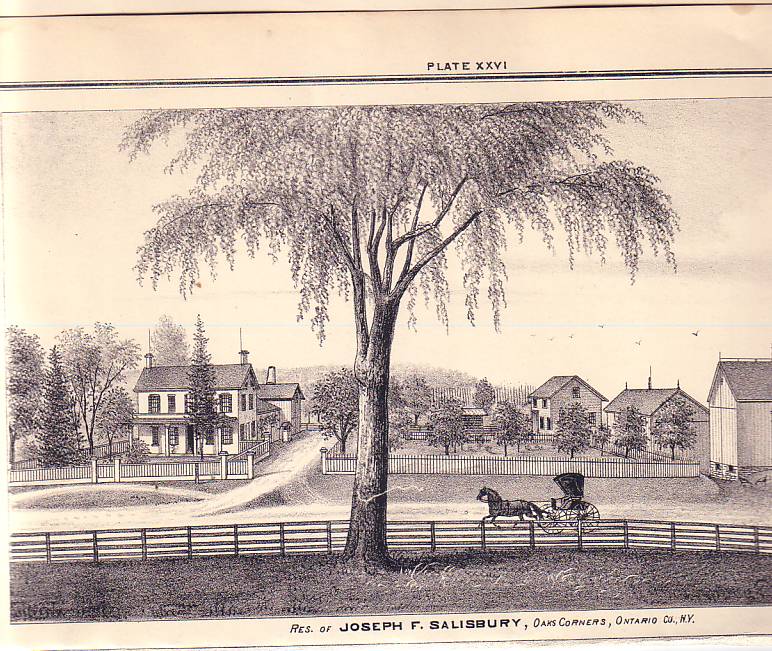
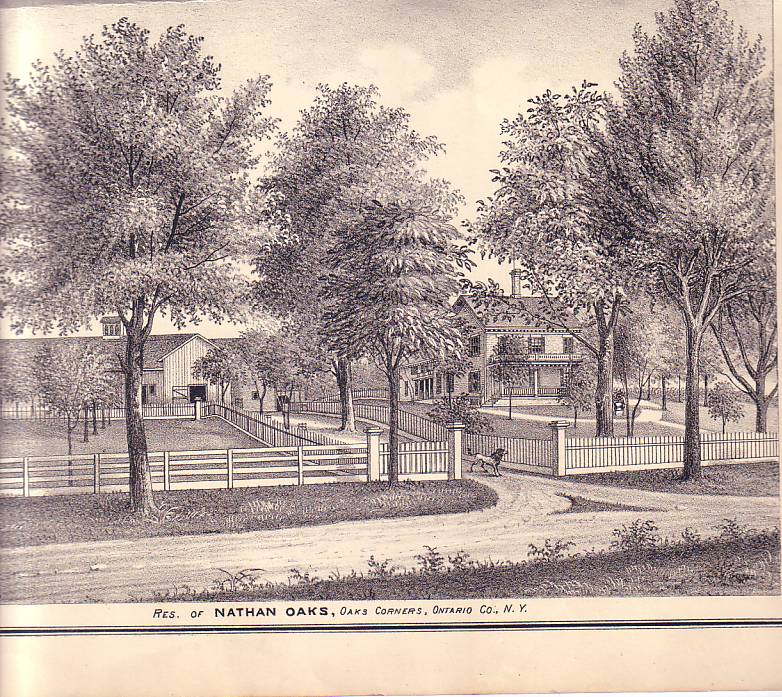
Mabel Oaks paper continues...
This is a dramatic letter and of especial
interest historically because it gives a new version of the accident.
Other records
state that a timber fell on
Cotten from above, but, of course, the family account should receive
greater credence. Today,
a great-great-grand-daughter, her two children and
a great-great-grandson wUh his five children are here to honor their
ancestor at our cemetery service later in the afternoon.
Well, the
work on the meeting-house had to go on. The $600 raised only the
framework--the skeleton. It did not cover
the roof or side the building,
lay the floor or put In pews or windows. So, in 1805, the trustees held
a public vendue
(auction) at Stephen Holland's inn, at which the vendue master
sold the pew ground, pew by pew, to the highest bidders.
There were no, actual pews as yet. In November 1807, Lemuel Bannister
(great-grandfather of Miss Loa Whitney)
received $4 credit on his pew purchases, in the church records, "by
bringing a lightning rod for the meetinghouse
from Albany". Even though the building was still more or less exposed
to the elements, the trustees meant to safeguard
it in this one respect at least;
the rod was probably Benjamin Franklin's earliest model. That same year--also in 1815
and 1817--vendues were held to sell the pews
themselves to the heads of families, average
price $45. Front pews
brought more than those at the back of the meeting-house, body pews (on
the center aisle)
more than ones against the
walls and in the three galleries or balconies. The terms of payment at
one February sale were typical of the times; $2
down, deposited in the hands of the vendue master; 1/3 of the residue
to be paid in lumber next May 1st; the full residue
by next January 1st. From
the beginning, It seems to have been
understood that pews should become the property of
Individuals, for two reasons: it suited the preferences
and tastes of the era, and church officials
thought this the best
method of raising funds.
All this time, the meeting-house was still
not finished. In 1807, Elias Cost and Joseph Hall were made a committee
to
"employ persons to complete the
building within one year for a sum not to exceed $1500, together with
the lumber in
and about said building". This committee hired David and James
Burnett "to be paid $1 a day and to find their board,
1/3 to be paid in cash". Many others worked on the meeting-house which
was finally declared
completed in 1816.
For most of those 12 years between 1804 and 1816, the undaunted members
worshiped there without pews, heat
or window
glass. They sat upon planks resting on blocks of wood; loose boards,
laid over the logs used for sills and
joists, were flooring. As for heat, each
family brought its soapstones and square, tin footwarmer, to be
refilled at noon
If possible. Oiled paper must have covered the wlndow-frames
until
1811, when Jonathan Melvin was appointed to
buy glass.
In our antique exhibit downstairs, Is a
copy of the Certificate of Incorporation of the Union Religious
Society of
Phelpstown, dated January 9, 1804.
Its first trustees were Philetus Swift, Daniel Shattuck, David Northam,
Jabes
Swan, Thaddeus Oaks, and Joseph Hall--recorded
as first, second and third class officer interesting nomenclature
referring to duration of their terms. Just a little
informalon about these men--Philetus Swift,
one of the area's most
prominent settlers, came to Phelps
from Vermont in 1789 and established very successful flour and saw
mills (later
known as Barlow's) on his large farm northwest of Oaks Corners. The old
brick building at Unionville across from
York Inn was his center of trade as a wholesale dealer in grains and
other produce; a large painted sign announced
"Swift's --Cash for Wheat". His teamsters with their 4 and 6 horse teams made regular trips to Albany with
wheat,
bringing back wagon loads of provisions unobtainable here. In 1816, he built the fine
cutstone house, today the home
of Mr. and Mrs. Lansing Hoskins, Phelps Road. His rank of General was
received during War of 1812, when he
commanded a regiment on the Niagara frontier. He was a judge of the
County Court and later a member of New
York State Senate. Daniel Shattuck, you
remember, was our church's builder; David Northam's home was the
present
John Hayes farm, and he is said to have taught school in District No. 1
in combination with farming; Jabez Swan lived
on Elmer VanInwagen's present property,
Thaddeus Oaks at Oaks Stand and Joseph Hall (a major in War of 1812)
on Arthur Day's place. When our schoolhouse was built, in 1812, Major
Hall's subscription toward it was $20, "to
be paid in shingles, shoes and boots"; every farm had its
shingle-shaving bench, and he must have used a cobbler's
bench as well.
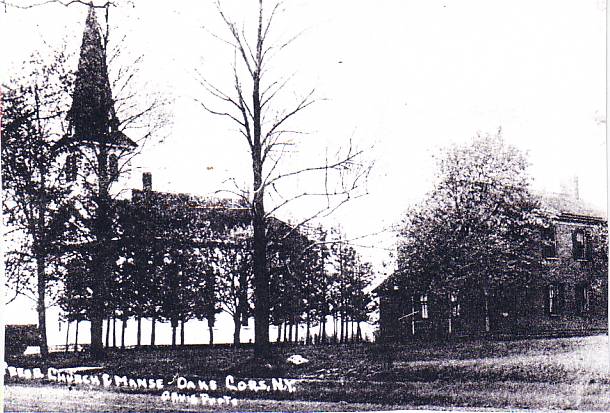
Of the 17 charter members of our church, I
can connect eight with present day people--Caleb
Case, John
VanAuken, their wives, and four Griffiths. Caleb Case was the maternal
great-grandfather of Mrs. James Weston
and lived on the site of the present manse; he was a very early elder
who died in office. John VanAuken's farm was
on the Lyons Road; his grandson, Col. George VanAuken and his
great-grandson Theron VanAuken both served
as elders. Theron's daughter became Mrs. Ambrose VanDeusen; since the
VanDeusens were very active in the
church, the VanAuken family, at our 1904 centennial, could point with
prIde to its record of 100 years membership
in the Oaks Corners Church--really 107 years,
since our church was surely born that night in 1797 when "A Christian
Association" was formed. However, we count Its age only from the
incorporation date January 1804. The four
Griffiths were ancestors of Miss Charlotte
Griffith, Clifton Springs, Allyn of Seneca Castle, and the Palmyra
Griffiths.
When our old church was raised, with one
exception (East Bloomfield), it was the only church edifice between
Geneva and the Pacific Ocean. Isn't that a breath-taking thought? We
were Congregational for a year or so,
undoubtedly because the Conway, Massachusetts, church was of that
denomination and most early settlers here
came from the Conway area. However, we joined Geneva Presbytery in 1813
and have been staunch members
ever since. We were organized as Presbyterians earlier by the Rev.
Jedediah Chapman of Geneva, it is recorded.
He was the first Presbyterian minister in this area and a most
important figure in Presbyterian history. It is of interest
that the Rev. Jedediah's brother, Ozias Chapman, was the maternal
great-great-great~grandfather of Mrs. Canton
Oaks.
I have already mentioned the physical
discomforts suffered by our first congregations. These were somewhat
mitigated by the purchase of two stoves for the meeting-house in
1817-the first stoves ever brought into the
Township of Pheips. Homes and inns were then heated only by
fire-places. Our record book contains this copy
of the order:
Phelpstown, December 1817
Mr. Prouty, Geneva
Sir: Be pleased to furnish as soon as posaible two stoves
for Union Religious Society and sufficient pipes therefor,
agreeable to directions Mr. Mosher will give you. The trustees will pay
for the same in four months from date if
furnished the present week.
By order of Board of Trustees
Joseph Hall Clerk
Please note the
late payment and the implication that if not
furnished this week, Mr. Prouty may whistle for some time for
his money. May I quote from a 1903 letter of reminiscences written by
Sylvanus Burtis when he was 84 to his niece.
Clara Burtis Porter? "In winter the church was very cold. There were
two large rectangular wood stoves on each
side near
the entrance and the stove pipes went the
whole length of the church and outdoors
through two windows just back of the
pulpit. We generally had green wood to burn and often the house was
filled with smoke. Most everyone that could brought footstoves, and
there was a lively time at noon to fill them with hot coals".
Another part of the same letter has a fascinating description of our
first pulpit - "In speaking of the church,
when we moved
to the farm in 1832 the church was well
attended. Our minister lived on the Swan place; he was very tall. His
name I will
never forget, William Rolling Sprawling Betts.
He just fitted his pulpit, which was of wine glass pattern on a tall
standard or
leg, with a narrow, shackling stairs and, poised over the preacher, a
sounding board of same pattern as the pulpit with a
kind of pagoda top. The object of having the pulpit so tall was
so that the minister could see the entire congregation; the
pews in the side galleries extended to the extreme front of the church."
From 1819 to 1823, we welcomed 153 new members (total
membership 210) and felt optimistic about the future. The
departure, in 1820, of 70 members to form a new church at Vienna
(Phelps village) was a blow, of course
but a blow the
full impact of which we did not feel until 1831. Though they left our
church bodily in 1820, the group kept its membership
and support here until 1831, because for
those eleven years we had a common pastor who alternated
between the two congregations, each house being closed one Sabbath while services were held in the other. 23 received dismissals in
1825 to start an organization at Newark,
today the large Park Presbyterian Church; again, in 1828, we lost
members when
Castleton (Seneca Castle) formed a new church. The Union
Religious Society of Phelpstown at Oaks Corners never
recovered completely from this triple lose,
never regained its old strength.
Here, I should like to make a few
revelations about our pastors' salaries. Our 1816 minister, Rev.
Charles Mosher, was
paid $500 a year, in two semi-annual payments and certainly earned the
money. His congregation extended over a large
territory, isolated members scattered here and there in different parts
of the township. His usual Sabbath services were
two sermons at the church and one at Vienna in the evening, a difficult
and exhausting pastorate. Three years later, we
promised $600 to Rev. Samuel Brace, "half
cash, half produce at market rates". It was voted by the trustees "that
the
Price of grain, for the support of Mr. Brace, be wheat .75, and rye and
corn .44 and oats .25." Every few years the pastoral
salary would be raised $100, but in 1832, we were back to $420 with
Rev. Wm.
R. S. Betts and unable to raise that.
Arthur Burtis and Jacob Cooper were made a
cornmittee
to discuss finances with him, but, in spite of our good
intentions,
after two years he resigned--of
course our church officers made up such salary deficits as soon as
possible. We have Rev.
Betts' original receipt; there was still a total of $27.08 due him from
our trustees, who were then Elias Cost, Jacob Cooper
and James Webster. Among Elias Cost's papers is a letter from
John R. Green, dated 1834, including this sentence, '
Money was never harder to be got than now." I am sure Rev. Betts and
our other early pastors heartily agreed with him.
At that time many pastors with short pastorates was the regular
procedure, undoubtedly because our society was as
poor in material resources as our church mice. The great national
financial panic of 1837 was approaching. As
late as
1847, we were paying only $450, and $400 yearly in 1858! The treasurer
reported at the 1859 annual meeting deficits
of $98 in the minister's salary and $200 in the parsonage fund; it was
decided to try to raise the amounts by subscription.
Many unexpected demands for such underwriting were made upon our more
prosperous members. By 1894, we were just
able to pay Rev. Henry Maier $700 and give him a vacation, too (a new
departure). Four years later we paid the same
pastor $800, and by 1905 a small balance on hand was usually reported
at the annual meeting; we had passed our
financial crisis. The church's poverty in some years may have been the
reflection of a national trend toward depression;
the panic of 1857 is mentioned in all histories.
THE CHURCH JUDICIAL
During the first half of the nineteenth century, our church elders were
often occupied in disciplining members. If you broke
the rules, you were suspended, forbidden to take part in communion
services; the neighbors would say, in shocked tones,
that you were "churched" for misdemeanor (misbehavior, an old meaning
of the word, today used in its legal sense only).
If you were absent from church a long time (particularly from communion
service), if you made, or even received, social
calls on Sunday in Oaks Corners in the early eighteen hundreds, you
were suspended. Men were churched for public
profanity and intemperance. Of course, there were a very few
indisputable sins, too. One man was
suspended for "
advocating the doctrine of universal salvation" -- another for "aiding in horse racing."
This last-mentioned misdemeanor
calls for an explanation. From 1816, for 25 years at least, annual 4 to
6 day races were held on a half-mile course in the
large, level field behind the meeting-house. Immense crowds
attended; horses were brought from as far away as Canada, Pennsylvania,
New Jersey and Maryland. The village common (on the east side of the
public road extending from the
church lot to the spot where the railroad depot stands today) was
occupied during the races by tin peddlers and hucksters
crying their wares. These gatherings at Oaks Corners were, in some
measure, to western New York what the State Fair
now is to the whole state. You can readily see that opportunity
to earn extra money "aiding in horseracing"
must have
been a temptation to many of the men, and they succumbed to that
temptation in numbers sufficient to arouse church
opposition so powerful that finally the project was abandoned. It
was nearly one hundred years before the racetrack was
plowed out of sight; you may remember when Arthur B. Burtis exercised
his horses there. The field was also used, in
early times, for the "general training," at which local men between 18
and 45 years of age were required to
assemble
annually for military drill, lasting 3 days. (From "Pheips Was Young")
Quite a few early members were suspended "for
uniti (unclear to me) th Methodists in a
disorderly manner" - not that the
Methodists were disorderly.
It merely means the members left our church without the proper
dismissals. However, we had
a definite reason for mixed feelings about Methodists. For nearly 40
years, our church had a mighty rival in a highly
successful camp meeting held each summer from a week to ten days, in
the woods behind today's crushed stone plant.
A 1903 issue of the Geneva Times related that, on one Sunday In 1867,
Edward P. Ryan (former Phelps hotel man)
reported the passing of 11,400 teams through the gate leading up to the
grounds; admission was charged for each wagon.
The number of people was not counted, but it must have been much more
than double the number of teams, as attendance
was generally a family affair. Preachers frequently were from the
cities, some nationally known. The "rigs" would go through
the gate just south of the stone crusher office, up past the Indian
Carpet (which many of us remember), between the zig-zag split-rail
fences to the edge of the grove that ever since has been called the
Camp Meeting Woods. It seems certain that Joseph
Smith, founder of Mormonism, attended these meetings. I quote
from the Ontario County Directory of 1867-1868: "The
father of the prophet, Joseph Smith Jr., was a Universalist and later a
Methodist, described as having been a smatterer In
Scriptural knowledge and a believer In the marvelous. Mrs. Smith
was a woman of strong but uncultivated Intellect, artful
and cunning; the first intimations that a prophet was to spring from
that household came from her. Their son, Alvah had
been first pointed out by father and mother as the chosen one, but his
spiritual nature was overbalanced by his carnal
appetite; he ate too many green turnips, sickened and died. The
mantle then descended on Joseph Jr.
"Joe" was a
lounger and Idler with an Intellect below the ordinary. However, the
embryo prophet had some of his mother's ambition and
after catching a spark of Methodistic fire at a camp meeting near
Vienna, he became a passable exhorter." The reference
in the preceding sentence must have been to the Oaks Corners
assemblages as ours were the only ones known to have
been held In this vicinity. Our woods were undoubtedly chosen as
the campsite because of their three large, never-failing
springs; the many horses and humans needed
great quantities of water for drinking, and the women had to keep their
kettles and coffeepots filled. I feel the story of the camp meetings is a colorful piece In the patchwork of our
community
history.
We are inclined today to underestimate the moral power of the early
church. Let me give a few examples of that power. First, the lumber
incident. At Obed Barlow's grist mill, with saw mill attached, great
heaps of logs lay from mill to road; they would saw this lumber and put
it in piles behind the mill, H, A. Steckels and Damon Wright, both
Society members, had lumber sawed and piled there and went to get it at
the same time. Steckels accused Wright of taking some of his lumber,
but the latter, feeling falsely accused, calmly continued to load it on
his own wagon. Mr. Steckels went to see Mr. Barlow and the sawyer
who declined to interfere. When he returned, Damon Wright had already
left with the load for the carriage shop (located near Oaks Corners
town hall) where he and his brother manufactured and repaired wagons
and carriages. They also made revolving wooden hay rakes. Steckels at
once took the case to our session, to the church court, charging Wright
with wrongfully taking 168 feet of lumber. The accused stated his later
discovery that he had taken 36 feet extra by mistake, expected to pay
for it but had already used the lumber In his shop. The session decided
Mr. Steckel's demands were unfair and charged Mr. Wright for the 36
feet only, at $1 per 100 feet. 'rhis was at once paid; both men
accepted without question the session's ruling.
The next examples of the church's authority have to do with
intemperance. In 1834, the church body put itself on record with a
lengthy resolution declaring its disapproval of "the traffic in ardent
spirits and the use of them as a drink." It had already proved this
disapproval many times. In 1817, Ruhannah ______________, living
on the Naham Cobb farm, Lester Road, received a summons to appear
before the session, as common fame charged
her with having been " for a long time in the intemperate use of ardent
spirits." She sent word she was sorry, promised to reform and to
come to the next session meeting. When she still did not appear after
two more citations, she was suspended and later excommunicated, put
outside the pale. The Interesting thing about this is that her son was
then a trustee of our church, which fact must have made this
performance of duty most embarrassing for all concerned. Cornhusking bees were held each year on the
farms; at John Taylor's bee, in 1827, one Richard Smith was said to
have been overcome by spirits so that it was difficult for him to
walk, In considering his case the session member chosen to defend
the accused attempted to prove that Smith's peculiar locomotion might
have been caused by rheumatism to which he
was subject. However, this was not Richard's first offense, and he was
excommunicated. There was obviously no misuse of church power here; the
session "leaned over backward" in trying to be not only just but
merciful. John Taylor's place, the scene of this little drama, was the
Edward J. Cook farm (later the Charles
Peachey place and
today the home of
Dr. and Mrs. Mack); Taylor had a family of 19
children and the reputation of being
particularly good and kind to the poor. Large families were then
the rule, economically necessary for success and even
for survival.
The Union Religious Society acted as a Society for the Prevention of Cruelty to Children in 1837. A Mrs. S__________ was accused of abusing and beating a 15-year-old girl living with her. A witness reported that, after shouting "I'll whip you to death, but I will conquer you," MrL S____________ struck 20 blows on the girl's head and neck, drawing blood; she used a 20-inch long beech stick, in shreds after the whipping. Needless to say, Mrs. S__________ was sharply reprimanded and excommunicated. The detail of these old session books is amazing. One woman was refused a letter of dismission from the church because she was not living with her husband; the session stated they must first be reconciled.
My final example of the church's pervasive influence for good is the story of Phelpstown's Horse Thief Society. Horses had been stolen from time to time; though owners had spent time and money freely, nothing was ever heard of them. The alarmed citizens held a meeting May 5, 1832, at th~ Eagle Tavern (Pheips Hotel) and formed a society to detect horse thieves, recover stolen horses and other property; they elected officers and chose 12 riders annually, Some Oaks Corners members were Elias Cost, Hugh Boyd, Joseph VanDermark, Jacob Shekell, Asahel Bannister, Wells Whitmore, Henry P Strong (our pastor himself), Arthur Burtis, Isaac Beall and the Swifts--all church members. The organization of this society with a notice of its energetic riders, with plenty of money to back them, published and conspicuously displayed, was discouraging for the gang who gave Pheips a wide range after that. Our early church men had again gone into action.
DEVELOPMENT
You know, of course, that Sabbath services were
formerly held both morning and Afternoon. I
quote again from Sylvanus Burtis' letter. "We used to start
church about 10 A. M., held an hour intermission and would reach home
about 4 o'clock. We always took a large
basket of lunch to eat during intermission. Sometimes we had
Sunday School." Sermons were longer then than now, geared to
death instead of life; it was small wonder the deacons needed their
long sticks for tapping on the heads of those who were nodding off to
sleep. Occasionally an early church would own a litter, on which to
carry out fainting parishioners during an extra long service or extreme
heat.
The year 1846 was a time of remodeling for our church building; the old box pews were changed to slips. I wish to quote from one of the June, 1886, historical sermons given by our pastor for that year, Rev. John P. Richardson. "An original pew of the church may be conceived of thus: an enclosure 6 feet square, a narrow door on one side entering from the aisle, the other sides all given to seats. When the pew was full, the preacher would see a row of people facing him, another row sidewise to him, and a third row with their backs to him. After 1846 another kind of pews, called slips, was substituted, still with doors, but long, narrow and provided with seats on one side only." I felt I must quote this authoritative description in order to be believed; undoubtedly children sat with backs to the pulpit, facing their parents--a position conducive to good behavior. They say there were two reasons why the early pews had doors--one reason psychological the other physical. Sitting in the family pew, behind a closed door, you felt completely encompassed by the service in mind as well as body; also, the door, in winter, kept drafts of chill air away from ankles. Our church was undoubtedly built after "squeak pews" had gone out of fashion. In some of the earliest Boston churches, squeaks were deliberately contrived, in order that everyone's arrival might be noted without the rude necessity for turnmg around; you were supposed to be able to tell from the direction of the squeaks which families were present and in what numbers.
In another sermon, Mr. Richardson spoke of the wide influence of our early church, not only here but in other sections of the country. We had, more or less, a drifting population then, scores of families coming into this parish and later moving on, carrying the church's letters of dismissal, to spread still further the rippling circles of that influence. A considerable number of our members became Ohio and Michigan settlers. Sometimes a pioneer would have no particular destination, In which case he would be given a letter like this one, written in 1833 by our elders. "For Samuel Clover and Minerva, his wife, a letter of dismission and recommendation to join that Presbyterian Church within whose bounds the Lord may cast your lot."
When I first read in a session record that Rev. Henry P. Strong supplied the "church at the ridge near Oaks" from 1824 to 1831, I was puzzled, as I knew he was pastor of this church during those years. Now I am convinced that long ago our Oaks Corners road was, in part, definitely a ridge road and so called; it must have been levelled out somewhat as the road was improved from time to time. Rev. Conway Wing of Carlisle, Peansylvania, a member here in 1822, used the exprssion "church at the ridge" in a letter. Osee Crittenden Jr., in his own words, "lived 13 years at a farm on the ridge near Oaks Corners." He paid $40 for a 106 acre property which he called the ridge farm; "his house (probably Irving Webb's present home built 1834) was a little west of the tavern at Simmons' Corners, where Abram Simmons kept a tavern and owned a farm." This was the corner by the Lehigh Valley railroad crossing on our South Oaks Corners road. Philomela Cooper Wright, in describing our first brick schoolhouse, wrote of "the very steep hill leading up to it on which many children suffered severe falls, especially in winter. When the house was altered, the hill was scraped down to make it safer" This surely bears out the idea of the ridge as do several other references.
During Rev. Morss' ministry, about 1850, the session
resolved to hold stated meetings the last Friday of every month,
" to pray for the revival of religion and concert measures to promote
the prosperity of the flock under its watch and care." Before
this time, they had frequently met at the meeting-house during the noon
intermission. This new resolution was carried into effect,
sometimes at members' homes or at the home of their pastor, which was
then the first house north of the church. The business of the early
session seemed to be of three general subjects: receiving and
dismissing members, electing elders and
disciplining backsliders. A subject quite different occupied the
attention of our church body In 1851, when Geneva
Presbytery asked us to give $5 toward support of the North Presbyterian
Church in Geneva. After due consideration, we decided It was "neither
just nor right" that we should do so and informed presbytery to that
effect. Who knows, one hundred years later, whether we were right or
wrong? I suppose the thought motivating our
refusal was that charity should begin at
home. (I have since learned, from Dr. Robert
Breed's history of the First Presbyterian
Church of Geneva, that the North Presbyterian
Church of 1851 had no connection with the present church of that name. A group had withdrawn from the Presbyterian
Church of Geneva in 1845 to found a
Congregational Church on the southeast corner of Genesee and Lewis Streets. The new society did not prosper
and in 1850, it joined Geneva Presbytery as
the North Presbyterian Church. In 1853 it disbanded.)
1858 was an important year; the Union Religious Society purchased its first parsonage. For over 40 years, pastors had been obliged to rent or buy homes wherever they could. Sylvanus Burtis and Nathan Oaks 1st were the committee in charge of purchase and repair, for the two-story brick bulding was not new. To explain this building, may we now go back in time tabout 30 years before 1858? Prior to 1834, a private school had been taught in the session room (later called the Christian Endeavor room) at the west end of our church, upstairs; Cotten Crittenden of Melvin Hill ( son of Osee Crittenden, Jr.) was the first teacher. Sylvanus Burtis speaks of attending and of a terrible tornado and hailstorm which broke nearly all glass out of the windows while classes were being held. This school was so successful that area leaders planned to have a building suitable for a permanent institution. In the spring of 1834, a subscription paper, headed by Col. Elias Cost, Elizabeth Burtis and Captain William Ottley, was circulated fo the building of an academy. Over $800 was raised; 58 names appear on the original paper, for sums from $125 to $.02. Dr. Joel Prescott 2nd and Captain Wm. Ottley served as building committee. Lemuel Bannister gave the bricks. For a number of years, the Oaks Corners Academy, located 100 feet south of the church, was an excellent college preparatory school with 50 or 60 students in attendance. Henry Doolittle (father of J. Seymour Doolittle) and Conway Wing (son of elder Enoch Wing) were students who became Presbyterian ministers. Lewis Peck, later the first principal of Phelps Union and Classical School and a graduate of Hamilton College, was one of the teachers--as was Joel Prescott 3rd. Sylvanus, himself a student, wrote "Mr. Bloomer and the lady who was afterwards his wife, with others, came daily from Seneca Falls and Waterloo." From this we may assume that Amelia Jenks (later Mrs. Dexter Bloomer), nationally known reformer, once attended this Oaks Corners school. She was living with a sister In Waterloo at that time. This is our first knowledge of girl students at the academy; we had supposed them to be all boys. Some from long distances boarded In the neighborhood. Our pastors were usually teachers, too After a time the academy ceased to prosper and then even to exist, as highways improved and the Auburn branch of the New York Central Railroad was built, The abandoned, somewhat dilapidated building was purchased reasonably and, after repair and alteration, became a satisfactory parsonage for the Society. Today the only visible reminder of its one-time existence is the large, stone horseblock, still Intact, close by the edge of the road.
And then it was Civil War time. The Union Religious Society was represented at Gettysburg by Rufus Holmes (son of Rufus, a trustee and active member) who died and was buried there. Others from our community fought bravely, too, Along with the war, the work of the church went on. The trustees, in 1864, decided to "let the slips" (rent the pews), as they could no longer raise sufficient funds by subscription and our membership had changed greatly since the days when each man owned his own pew. The same year, the congregation voted to change the wine used for communion purposes from currant to pure grape, since some disapproving members considered the currant wine essentially social rather than scriptural. The next ten years were a missionary era in the history of our church, the records reveal, but the following statement surprised me. They voted to hold a missionary concert at the church, one Sabbath each month during 1864. Knowing the attitude of the church of that day toward music and its association with dancing and having just read the criticisms leveled at an early choir leader who brought a bass viol into church (the elders called it "a disgrace to have a fiddle in the house of God"). I could not at the moment understand. Then I realized they used the word concert in the exact meaning of its Latin derivation--planning or acting together; today, I believe, we generally use the noun in its musical sense only. As you know, our forefathers' English, oral and written, used many more Latin derivatives than we do and so gained in dignity but often lost in force. Also in 1864, George VanAuken had been an elder 30 years, Cotton Dickinson 2nd for 25 years and Hiram Armstrong 20 years. Now to these veterans in the service were added two new men, Theron VanAuken and Ezra J. Peck. The latter two were still elders in 1886.
After the Civil War, the North enjoyed a period of prosperity, and our trustees voted to raise the large sum of $4500 for much needed church repairs. This was In 1866; our pastor was the Rev. A. T. Young, grandfather of Mrs. W W. Hopkins of Geneva. He was with us 13 years, serving the church the longest of any of its ministers. At this time, the roof was newly shingled, the sides clapboarded and painted; inside the building, the side galleries were removed, new slips without doors put in and the walls frescoed. Two angels holding trumpets were painted on the ceiling just above the pulpit. We now had a seating capacity for 250 to 300 persons. Services continued in the Crandall Hotel during repairs. The cost of all this swelled to $5000; we had 112 members at the time. Liberal contributions were given by Cooper Sayre, Dorance Kirtland, Hiram Armstrong, Nathan Oaks, Vincent Reed and many others, but in spite of this it took over 10 years to pay this debt in full. One Sunday In 1878, our next pastor, Rev. Julius E. Werner, unexpectedly introduced the subject of the debt, made an eloquent plea for subscriptions and, "by seeming sudden impulse," the debt was paid.
In 1873, we changed our name to the First Presbyterian Church of Phelps at Oaks Corners; the Union Religious Society of Phelpstown was no more. Our Women's Missionary Society was founded 1874 by Mrs. A. T. Young. She never lost her interest in this Society and remembered it in her will. In 1876, pew rentals were collected weekly in envelopes, and 1893 saw the end of pew rentals and the beginning of our present envelope system. The Christian Endeavor Society was established 1890 by Cornelia Peck Lindsay (wife of Dr. Peter Lindsay of Rochester and a daughter of Ezra J. Peck) and flourished for many years. As early as 1869 we had a Sabbath school library; I remember it well. For 50 years Oaks Corners enjoyed a fine public library which was absorbed by Geneva city library after it had outlived its usefulness to the community. George Mann Peck and Mrs. Raymond C. Ross were two of its librarians. The old library building, attractively remodeled, Is now the home of Mr. and Mrs. Roland Archer. Enterprise Grange organized October 2, 1889, In the old town hall with 20 charter members: Mr. and Mrs. Charles H. Holbrook, Mr. and Mrs. A. J. Weston, Mr. and Mrs. E. H. Hammond, Mr. and Mrs Wm. A. Oaks, Mr. and Mrs. Martin Louw, Mr. and Mrs. Oscar J. Whitney, Mr. and Mrs. Eugene Bruzee, Mr. and Mrs. Samuel P. Farwell, Mrs. John Cross, Miss Addle Cross, Mrs. Scoville E. Shear and Mr. E. G. Bullard. Mr. Holbrook was elected the first master; he died shortly after his election, and Scoville E. Shear was chosen to fill the vacancy. I quote a part of the resolution adopted by the Grange at that time: "While bowing with submission to the all-wise disposer of all events we desire to bear our testimony to the excellence of our departed brother Charles H. Holbrook as a gentleman and a citizen and tender his bereaved family our sympathy and condolence." Through the years, the Grange with its educational and social program has done much to effect a better local citizenry. The Grange has always worked in close cooperation with the church for the benefit of the community. At present the two are joint sponsors of the annual winter minstrel show and the chicken barbecue supper held each August. One of the current community projects of the Grange, under the chairmanship of Dr. Alvin W. Hofer, is improvement of the pioneer cemetery opposite Miss Whitney's. No burial has been made there for many years; the spot has been nearly forgotten since the death of Seth W. Armstrong who regularly tended it gratis, with his scythe, as faithfully as his father Hiram before him had cared for the church building. The oldest stone in the graveyard bears a date in 1801; we find there, among others, the names of Swift, Oaks, Dickinson, Humphrey, Pullen, Chase, Griffith, Case, Young, Cross, Armstrong, Holbrook, Sayre, Burtis, and Skuse. On the stone wall in front of the cemetery is carved the date of its laying, 1828.
BIOGRAPHICAL SKETCHES
Here, I should like to go back in time once more and introduce sketches of some of our earlier churchmen, so that you may think of them as people, and not just names. Basis of Information is "When Phelps Was Young,"
Wells Whitmore came into the district with Jonathan Oaks in 1789, from Conway, Mass. He was a skillful carpenter and iron worker; most of the elaborate Iron railings and fences around the early lawns, gardens and cemeteries of this area were his work, He helped build Oaks Tavern and our old church, you remember-- also the mills of Pheips and Geneva Hotel. He was made constable at the original meeting of the Town of Seneca 1793. A brother-in-law of Philetus Swift, the two men were associated in many activities. In Masonic circles, he was Senior Warden at the installation of Sincerity Lodge in Vienna. His home at Oaks Corners was close by the south edge of the old Simmons burying ground (Oaklawn cemetery) the cellar hole is still visible.
Jonathan Oaks, too, was a first officer in Geneva's District of Seneca in 1793, before our township was organized, He was one of three path-masters (highway overseers) in charge of road districts; they had to "warn out to work" all men assessed for highway labor in each district and see that the roads were kept in repair. At that date it could have been little more than a supervision of Indian trails. Histories use the term "roads," but "paths," as the title of the office Implies, may have been more correct. Since Jonathan died in 1802, his son Thaddeus, while still in his twenties, had to shoulder the responsibilities of managing a busy inn and farm. However, until his death at the age of 50, he always found time for keen interest in church matters, politics and agricultural advancement. When the first county agricultural society was formed In 1819, he was the representative for the Town of Pheips.
Augustus and Ellas Dickinson were two of the first settlers in the town. Augustus' land lay north of Vienna, his brother's northeast of Oaks Corners,
The Eli Dickinson home is
believed to have been the first house east of Claire Bennett's; high
above the road, the house has disappeared, only a tangled mass of
shrubbery remaining. Here Cotton Dickinson 1st must have lived until
his marriage to Nancy Pullen, daughter of Nicholas Pullen (not
Nicholas' widow, as has been erroneously recorded). Cotten 2nd and his
son, G. Milton Dickinson, both were long term elders in the church.
As early as 1791, Walter Chase settled on the Carter Road, where he
owned a large farm. He was a stanch supporter of the church and the
great-great-grandfather of John Chase. The Chases are an example of
family continuity. Today, George Chase 2nd, of the sixth generation
from Walter, together with his father,
operates a large part of the original acreage.
Oliver and Charles Humphrey were very early
arrivals in the District of Sullivan; their lands north of Oaks Corners
all lay in the "gore," that is, they were east of the Pre-emption line.
Oliver held office in the Town of Seneca and became, with Patrick
Burnett, the first poormaster (overseer of the poor) in Phelps when this township was formed in 1796. His
brother, Charles, was elected a pathmaster. Oliver Humphrey, veteran of
the Revolutionary War, served in the War of 1812 at Buffalo and in
other actions. Hugh Humphrey was his great-grandson.
In 1794, Joseph and Lodowick VanderMark, early trustees of the church,
came up from Pennsylvania and occupied extensive lands north of the
Canandaigua Outlet; they were builders of several saw mills. Charles E.
Vandermark (a grandson of Lodowick) and his wife Charlotte were
supporting members 0f our church. A family
history states that he had an ornamental fruit farm at Oaks Corners.
This is now the John Hayes farm. His daughters participated in church
work and were lifelong friends of the John Cross daughters. Family
descendants in this area are Mrs. Oliver Crothers and her brother,
Gardner VanderMark, of Phelps.
Osee Crittenden Sr. arrived in this section from Conway in 1795, with
his wife and seven sons. Crittenden Interests have always been--and still are near
Melvin Hill. However, Osee Jr., after marriage, lived for some years
near Oaks Corners on the Cooper place (now the property of Irving
Webb), was an active member and elder of our church.
Solomon Goodale, whom I have already mentioned as the first town clerk
of Pheips, left Conway in 1795. He proved a highly respected,
well-liked preacher and exhorter here and in surrounding communities;
he also taught in early schools. The Baptist church at Melvin Hill
secured him as their first pastor. After ten years in this township, he
moved to Bristol, preaching there until his death at the age of 94.
Mrs. Fred Hutchens of Pheips is his great-granddaughter.
John Salisbury cleared his acres west of Melvin Hill. He had come here
in 1789 with Jonathan Oaks' party for adventure but returned to Conway.
In 1796 he again came to Phelps as a real
pioneer with a bride. He was the great-grandfather of Miss Anna
Salisbury and her brothers, J. Lewis and Frank A. Salisbury. Their
grandfather, Benjamin F. Salisbury, was one of the supporters of our
church 100 years ago. Benjamin held the town office of poormaster for
some time after the Civil War. It was then a duty of that official to
temporarily quarter some of the poor in his own home; they stayed in
back rooms upstairs and up attic, helping with farm work when able.
This home arrangement was probably carried out during periods when the
county house (built in 1826 on the same site as the present building)
was filled or when delays occured in admissions Transients, too, were sometimes kept in the poormaster's house
overnight or for a few days. Joseph F.
Salisbury, an uncle of the present generation, lived for years south of
Oaks Corners and held important offices in the church. His farm is now
owned by Monroe Day.
Also in 1796, Deacon Jesse Warner made the long trip from Conway to
this area, settling at Orleans. He was the main founder of the Baptist
Church there. Both the church and first schoolhouse were built on his
land, the sites given by him. He was appointed a commissioner of
highways at the first town meeting of Phelps. Jesse was the ancestor of
all Warner branches. His son Rufus, who settled near Hopewell, was
great-grandfather of Justice Earl S. Warner of Phelps. Mr. Warner is a
retired Justice of the Supreme Court of the State of New York. Mrs.
Warner is a descendant of Lewis and Charles Holbrook, early church
trustees at Oaks Corners. The Holbrook property is now the Charles West
home.
Captain Lemuel Bannister came into Phelpstown with his family at a very
early date, about 1798, and purchased lands
just north of Oaks Corners. Two of his sons, Lemuel 2nd and Asahel,
soon owned successful farms and mills. Lemuel 2nd built in 1825 a
large, dignified brick house, the lifelong
home of his great-granddaughter, Miss Loa E. Whitney. The bricks for
this house, for the near-by schoolhouse and
for the Oaks Corners Academy were made on the home place with their own
clay. Both Lemuel and Asahel were loyal, generous members of the
Religious Society. Asahel operated an inn on the Pheips road, today the
home of Ned Forbes. The Bannister family was deeply interested in
educational work. Dr. Caleb Bannister, another son of Lemuel 1st, was
an important resident of Phelps for many
years--a teacher, physician and school
commissioner. His 1852 Agricultural Society address on local history is
of great importance; later historians quote from it.
Miss Whitney is also a great-great-granddaughter of Capt. Jonathan
Whitney of the Old Castle Farm, Geneva. Both Whitneys and Bannisters
were from Conway; it is truly amazing that most of this area should
have been peopled by families from this hill hamlet no more than twice
the size of Oaks Corners. The settlers' departure must have made Conway
a ghost town and stripped the countryside.
Colonel Elias Cost, who appeared on the Phelps scene from Maryland
about 1800, was a most interesting and
important man. He had his fingers in every business and political pie
in the area. At first, he owned the Kirtland farm; when he married his
second wife, Fanny, widow of Thaddeus Oaks, he built for her the
stately white-pillared brick house, now the home of Mr. and Mrs. Canton
Oaks. His military ranks are of interest, too. He was Captain Cost on
the night he was at Sodus, during the War of 1812, when the British
attacked the Point to capture stores hidden there; Asher Warner was
killed in that engagement. He was Major Cost when appointed chairman of
a committee to complete our meeting-house in 1814. As Colonel Cost, he
served as first postmaster of Oaks Corners, when Andrew Jackson was
President, and later as a Whig Member of Assembly at Albany. After his
death, the Loomis family purchased the property. Mrs. Loomis, mentally
confused In her later life, delighted in an attic swing, built
especially for her, and spent hours there reliving her childhood. The
swing has remained in the attic all these years; it is said if you
steal very quietly up the attic stairs, you may see the empty swing
moving gently back and forth as though she had just left it. Few have
tiptoed silently enough to see it swaying,
Darius Peck came to Phelps from Conway in 1805 The Peck family has always been of importance in the field of education.
Hon. Lewis Peck was principal of the Pheips Union and Classical School
for many years, as was Prof. Ezra J. Peck, his cousin, later. Ezra J.
was also a member of the State Board of Regents' Examiners at Albany.
Teachers and librarians in the family have been many-including George
Mann Peck, his sisters Edith and Anne and a nephew, Henry VanHoesen,
librarian of Brown University for many years. The pioneer Pecks were
active workers in the first Baptist (Church at Melvin Hill, and later
in our own church. The Weston farm was earlier the home of Dr. Enoch
Peck, father of Mrs. A. J. Weston and of Ezra J. Peck The Ezra J. Peck
homestead, with its pond and island on the Lester Road, was known as
"Tanglewood;" George Peck, as a young man, was a Spartan who enjoyed
his morning dip in the pond even in months when ice filmed the water.
The Charles Peck farm, one road west of Tanglewood, now in other hands,
is one of the most imposing in the area, beautifully situated on a
gentle rise of ground. The present Charles Peck of Phelps is the
great-great-grandson of Darius the pioneer.
In the year 1805, William Ottley emigrated directly from England to
this township. Captain William Ottley 2nd married Lydia, a daughter of
Darius Peck, and built in 1826 the dignified brick house at the end of
the road leading west from Oaks Corners, at present the farm home of
Mr. and Mrs. Leroy Facer. A sister of Captain Ottley became the wife of
Lemuel Bannister. A daughter, Sophia, married Theron VanAuken
(great-grandson of the pioneer John VanAuken), an outstanding member of
our Religious Society for many years; his daughter, in turn, became
Mrs. Ambrose VanDeusen. This family, too, was most active in our
church. The corner on which the old brick home stands is still spoken
of as VanDeusens' Corner.
Michael Musselman, a brother-in-law of Philetus Swift, settled at a
very early date east of the Corners. In session records for 1814, he
was chosen both a trustee and church attorney. At that time church
officials were most firm and businesslike about collecting pledges. If
you owed the Society over $25, legal suit was brought against you at
the next term of court; if the amount due was under $25, the church had
its own appointed attorney whose duty and right it was to collect
promptly.
Daniel Trowbridge, an eIder, organized in 1818 the first sabbath school
ever held in the township, also the first regular prayer meeting. He
was a cooper by trade and lived where Arthur Parker does now.
His neighbor, Jacob Cooper (spoken of as Judge Cooper), owned the
Albert Ribble place and strongly supported the church, serving on
numerous committees and as trustee. He and Asahel Bannister were the
first two Sunday School teachers. Jacob Cooper was a charter member of
the Masonic Lodge at Pheips. He was the maternal grandfather of J.
Seymour Doolittle and great-grandfather of Mrs. Katharine Angevine and
the Wallaces.
The house of Captain Nathaniel Merrill, soldier in War of 1812, stood
on the site of the home of Dr. Alvin Hofer and his family, The present
house may be the original one. Capt. Merrill received wounds at the
Sodus Point action. We believe he was a member of the 1803 Geneva Water
Works Company; he must have been living in Geneva at that time. In
1797, the village of Geneva was furnished water in log pipes from the
White Springs, but the company was not incorporated till 1803. (From
1876 History of Ontario County) . You may see one of these early pipes
at the Geneva Historical Museum. Mrs. Anna Harris and her brother, Col.
Samuel H. Merrill of Geneva, now retired, are descendants of Nathaniel.
The next time you drive up Melvin Hill in your car, please remember
Jonathan Melvin who, in 1791, took an Indian trail directly west of
Oaks Stand. After walking through the woods over two miles, he followed
the path up a steep hill. At the top, he climbed a tree; looking all
about, he could see the clearings down at Oaks Corners and decided that
was where he would make his clearings on the spot that ever since has
been known as Melvin Hill. Having plenty of capital, he soon had a
prosperous 800-acre farm and built, with $1000 of his own money, a
Baptist church at the hill just east of the present cemetery Tradition
says this was erected in 1802; the earliest records of the organization
are for 1808. The inscription on the large boulder marking the site
includes the date 1791, which is confusing. Miss Ina Jamison,
Jonathan's great-granddaughter, attended Sunday School there after the
building had ceased to function as a church. After it had fallen into
disrepair, many of the hand hewn timbers were put to further use in the
Salisbury farm barn still standing west of the hill. The pioneer Melvin
was active in two churches simultaneously, the records prove ---his
Baptist organization and the Oaks Corners Society This was probably
because of his great interest in the welfare of this whole area; my
personal theory is that he may have been a Presbyterian with a Baptist
wife and achieved domestic harmony in this way. His home was also an
inn, where he never refused food and shelter to any traveler. This
remarkable man had a log schoolhouse built as early as possible, later
replacing it with a frame building. Many of his 13 children must have
learned their three R's here. Around 1870 the present brick schoolhouse
(today used as a home) was erected on the same site at the top of the
hill. When his inn was filled with guests, Jonathan frequently offered
sleeping quarters in the school; the family of Darius Peck lived there,
with classes In session, for seven weeks while their double log cabin
was being built. In his first year at the Hill, while walking home from
Geneva, he helped himself to several apples from an old Indian tree
growing along the trail. The owner of the lot scolded him for
trespassing, to which Jonathan replied, "What a mean man you must be!
Next spring on my land I shall plant one hundred apple trees by the
public road for the use of passers-by". He did this; the trees thrived
so well that they are said to have given the first Impetus to the fruit
Industry in this township. Jonathan Melvin always wore a leather apron,
an ordinary one for everyday and one of fine buckskin for best; he
probably bought the aprons at John Warner's tannery in Orleans. This
noteworthy pioneer died in 1841 at 90 years of age. (From "When Pheips
Was Young").
Now let us turn our spotlight of memory on the physicians who have
served Oaks Corners. The next time you drive past Peck's Pond toward
Phelps, you will see on the east side of the road a little farther
north, if you are observing, the old cellar hole above which Joel
Prescott Esq. built his home in 1790-the first doctor in the whole
district. He owned the 100 acre farm we speak of today as Tanglewood
and rode out from there at all hours of the day and night to visit his
patients, their medicines in his saddle bags. They say he wore long
stockings and short breeches patched with deerskin so they would not
wear out so quickly in the saddle. Dr. Prescott was a relative of Col.
Prescott of Bunker Hill fame and, in all probability, of Dr. Sam
Prescott who rode with Paul Revere, but was not Immortalized by
Longfellow. Boston was a small town in those days; there would not have
been many Prescotts, and any family with one member a doctor frequently
has others in the same profession. During Dr. Prescott's 21 years of
practice here, he became highly respected and even beloved by people in
all walks of life. His advice on many matters was often asked--and followed.
At the first town meeting he was elected an
assessor, also served as school commissioner.
He was Supervisor of the Town of Phelps for
10 years and several times chairman of the County Board of Supervisors.
When only 52 years old Dr. Joel Prescott became suddenly ill with an
unknown disease and died after a few days of great suffering. It is
related that on that October Sunday afternoon in 1811, 1200 sorrowing
people attended the funeral service at his home. Roads were lined for a
long distance with wagons and carriages as the entire countryside paid
him their last respects. The pioneer doctor is buried in Joslyn
Cemetery. (From "Phelps Was Young").
Dr. Joel Prescott 2nd had been studying medicine with his uncle for
several years and now succeeded him in the practice, continuing his
studies under Dr. James Carter of Geneva,
whose family, we believe, gave the Carter Road its name. Dr. Prescott
was one of the founders of Oaks Corners Academy. After marriage, he
lived in the house opposite Edward Haslett's until 1839 when he moved
to Macedon. Oaks Corners' third physician was Dr. John Spaisbury who
occupied a house on the east road for many years. He, together with his
wife and three daughters, participated actively in church affairs until
his removal to Naples in 1865. A Dr. Higby, too, according to an old
map of our hamlet, was living on the Carter Road corner one hundred
years ago in the house now owned by Ben Pickard. Young Dr, George
Church and his family resided in our parsonage In 1877; Rev. Julius
Werner, our bachelor pastor, roomed and boarded with them, Later Dr.
Church's home was the house on the west road, now owned by Mrs. Cora
Overslaugh. Do you remember the interesting circles of old boxwood on
either side of the path to the front door? From this house he went out,
with horse and buggy, to minister to the ills of the community for many
years. Dr. Church was the father of Mrs. Angevine and the late Mrs.
Grove Symonds. These were Oaks Corners' five resident doctors. Much of
the information in these personal sketches is from the booklet "When
Pheips Was Young." I have no wish to plagiarize but have used the
material to round out the picture of early Oaks Corners, knowing that
many people do not have access to the book.
Now a mention of Arthur Burtis, a generous supporter of the church,
grandfather of the Arthur we knew and great-grandfather of the present
Charles B. Burtis, Rochester, and his sisters. The early Burtises owned
the Southgate and Soles properties; they were one of the prominent
families of the area. In the Southgate house once paced a panther whose
cage was the upper floor of the west wing of the house. The
circumstances under which this strange household pet was acquired by
some member of the Burtis family we do not know, These two adjoining
farms were, in more recent years, the homes of Vincent Reed and his
son, Vincent Reed Jr., both elders in the church, and then of Henry M.
Reed, a trustee, The later Burtis' home is now the Cebern Lee house.
Henry B. Burtis, father of the present Rochester generation, was a
faithful trustee for many years, chairman of the building committee for
our new church and always loyal in other ways of service.
Charles and Philetus Skuse, originally from Cork, Ireland, were
settlers here before 1830. Elias Cost's account book, owned by Canton
Oaks, records the following item "let the house and garden on the
Taylor place for a year to the Skuse boys-also barn- $25." Later they
purchased the Thomas Jones farm on the Carter Road, known to us for
years as the Frank Skuse farm. The early Skuse men-including
Elisha-were coopers by trade for three
generations. In the same account book is a record,
made in 1840, of the sale of "cooper stuff, red oak tree" to Charles
Skuse. Both Charles and Philetus Skuse are buried in the old cemetery
north of the church. Charles was the great-grandfather of Miss Lena A.
Skuse and the late Howard H. Skuse, an elder of our church.
By 1830, the Crosses with their sons John and Samuel (who later moved
to Junius) had been established for some time on their farm at the
north end of the Carter Road. They had come up from Maryland with their
slaves, wagons, riding horses and coach, and joined our church almost
at once. The John Crosses were generous givers of beef for the pastor's
family and loads of hay for his horse. Other members, too, gave in this
way.. The Cross daughters were constant workers in the church; Miss
Adelaide was organi~ for over 30 years, playing for three services
weekly, She was also a talented artist who, all her life, painted in
watercolor and made exquisite wax fruits. Their delicate bloom was her
own recipe, known only to her and a younger sister. After Adelaide's
death in 1907, Mary continued the wax work for a time, never revealing
the secret of the formula, though she had opportunities to sell it.
Geneva's Agricultural Experiment Station used Miss Cross' perfect
specimens of fruit for display and study purposes; her grapes may be
seen in the west cases on Jordon Hall's second floor. Other fruits
might still be shown there had they not, in some mysterious manner,
found their way into antique shops. Her wax exhibits won citations at
the 1876 Philadelphia Centennial; the entire Cross family attended.
Miss Addle and her sisters had a large summer house on the limbs of an
old locust tree on their front lawn. Winding stairs, with a curved
branch for railing, led to a wide platform. Here, on fine afternoons,
Miss Addle would dispense tea and poetry to her church friends from a
canopied tea table. Smooth circles on the tree, where branches had been
sawed off to make space for this shady retreat, bore scenes painted by
the hostess. The John Cross farm has been the home of Mr. and Mrs.
Myron Willson for nearly 50 years.
Cooper Jagger Sayre, a church trustee, came to Pheips Township in 1839,
moving here from a farm in Rensselaer County;
his parents, Enoch and Mary Sayre, both well past middle age.
accompanied him and his family. Cooper Sayre
was a public-spirited man, active in town affairs, particularly in
matters cf education. An avid reader, he had a life-long interest in
good literature, in agriculture and in religion. For four decades he
was a highly esteemed and important member of the Oaks Corners Church.
His father and mother are buried in the pioneer cemetery north of the
church; Enoch was 90 years of age at his death. The homestead, at the
top of the hill on the Frank Salisbury road, has remained in the
possession of the family since Enoch and Cooper Sayre settled there; it
is now owned by Enoch's great-great-grandson, Sayre MacLeod 2nd of New
York City, who supervises farm operntions and maintains a home on the
north end of the property.
Next, an especially honorable mention for Hiram Armstrong, grandfather
of Mrs. Raymond C, Ross, Mrs. 0 J. Blakesley and Miss Leonora B.
Armstrong. He served this church as trustee, as elder 25 years or more
and as our unpaid, volunteer sexton for 40 years. Surely that was a
severe test of loyalty. In winter, two downstairs stoves had to be fed
four foot wood. A fire had to be built in the smaller stove upstairs
both Sunday morning and evening--for the primary class of Sunday School and for
Christian Endeavor meeting in the evening before the adult service.
There was also the Thursday evening prayer meeting to prepare for. The
thirty lamps had to be kept clean and
filled. There were emergencies
like the Sabbath morning he arrived at church to find the brass
chandelier fallen from the ceiling, its lamps and their frosted globes
lying shattered on the floor, kerosene seeping into the carpet. In
earlier years, the office had sometimes been
sold at auction to the lowest bidder. In 1822, "the ringing of the
bell, making of fires and sweeping of the meeting-house" were alloted for the year to Sittman Glover who had bid
$34.75 for the doubtful privilege. A year later, Benoni Glover was the
successful bidder, his price $35. Hiram Armstrong's years of devoted
service to the church are a high example for us all. Most candidates
and new ministers of the time were entertained at his home. The present
Richard Minns property was his farm. At the home of her uncle, Hiram, lived Miss Eliza Warner, always devoted to the
church; the large Bible used in the first building was her gift. In
mentioning the early settlers, I have occasionally used only their
first names, but the old names themselves have such inherent dignity
that there seems no disrespect in so doing,
Around 1875, Rev. Henry Doolittle was active in our church work. He had
attended the academy here and graduated from Auburn Seminary. He held
several charges in this state and in Michigan before returning to Oaks
Corners because of ill health, Here, he turned his attention to the
cultivation of small fruits. Taking wild raspberry plants, he set them
out, propagated them and gave to the world the well-known "Doolittle
Black Cap." Mr. Doolittle also wrote a manual on raspberry culture.
Oaks Corners is mentioned in directories of the time as noted for its
berries. After a few years, his health improved so that he occasionally
preached here on the Sabbath; he was the father of J. Seymour Doolittle
and of Mrs. Church. Mrs. Doolittle was a daughter of Jacob Cooper and
served as President of our Women's Missionary Society 18 years.
Mrs. Henry Doolittle's sister, Philomela Cooper, taught school in
many districts before her marriage to Charles S. Wright. Her
remarkable, informative letters written years ago have furnished much
material for this history; her husband served
as postmaster here for 20 years, besides managing his carriage
manufactory, until his health failed.
Nathan Oaks 1st was also postmaster for a time and supervisor of the
Town during the Civil War period. He was a faithful trustee of the
church for many years. The Nathan Oaks farm is a Century Farm of New
York State, so named by the State Agricultural Society. It has been in
the possession of the Oaks family 165 years, continuously operated by
them,
SCHOOLS
When our town was first organized, Joel Prescott 1st, Oliver Humphrey
and Solomon Goodale were appointed school commissioners to inaugurate
the public school system. At the time, Solomon Goodale was holding
classes in a room at Oaks Inn. About 1800, all children in the township
came to Shekell's log schoolhouse, since known as the A. J. Weston
district. A committee of five men--Joel
Prescott 1st, Philetus Swift, Jesse Warner, Pierce Granger and Samuel
Miller-decided boundaries of three new school districts--Melvin Hill, Vienna and the Cape. Our District
No.1 brick schoolhouse, now the home of Mr. and Mrs. James McCarthy,
was erected in 1812; we have the original subscription paper, and it
makes interesting reading. Subscriptions were in lumber, wheat, bricks,
whiskey, neat cattle, labor, glass. nails and
lime as well as in cash. The log house in the Weston district was
replaced in 1818 by today's brick one. In the earliest days of
settlemen, homes would sometimes have a room set apart as the
schoolroom. A wide plank partition in Myron Wulson's barn still shows
parts of the multiplication table written when it served, long ago, as
a schoolroom wall in the first Oaks frame house near-by. Cross and
VanderMark daughters are known to have attended here later. Early
schools were in session three or four months during a year; the pupils
learned only the three Rs and spelling, Our old "Oaks Corners school
was English in style, with a series of graded platforms or steps. As
the student advanced in his studies, he sat in a higher row of seats
until he had reached the upper form." (From "When Phelps
Was Young") Mrs. Wright remembered that the only backs for the seats
were the cold brick walls and that teachers
used their inevitable ferrules often and well. Teachers boarded around
from house to house, the length of stay in each home depending on the
number of school-age children in the family.
Our first Oaks Corners schools were probably "blab" schools; it was the
country custom to have pupils study aloud, often with hands held over
their ears to shut out the surrounding hubbub. Abraham Lincoln attended
such a school. A far cry from that to centralization.
OUR CHURCH IN THE 2Oth CENTURY
Quickly the years slipped by till 1904, and our church was 100 years
old, our membership 140. Edward Hammond's history given at the
centennial celebration was a masterpiece; he and his family were
closely associated with the spiritual life of this church. Their home
was the farm now owned by Mrs George Hay. A son, J. Eaton Hammond, is a
Rochester resident. The Doolittle, Armstrong, Weston and Kirtland
families were comparable to the Hammonds in their devotion to Christian
ideals as applied to daily living. The personalities of the Misses
Carrie and Mary Kirtland and of J. Seymour Doolittle were outstanding
in spiritual-mindedness. Another noteworthy family was that of J. K.
Mickelson, all highly regarded members of the church
over a long period. Also active in the church were the Farwell.
Hood, Day, Bruzee and Reed families. The celebration of the
one-hundredth anniversary of the Oaks Corners Church in 1904 was a
two-day affair; nearly 300 attended. A
centennial dinner was served in the old brick parsonage; Mrs. Myron
Willson remembers that she, with other young girls of the community,
waited on the tables. Most early socials and suppers took place in the
homes. Elders in 1904 were Vincent Reed, J. Seymour Doolittle, Edgar
Pierce, Joseph Salisbury, Milton Dickinson and Stephen Vaughn, Our
treasurer was James H. Weston, Church trustees in 1908 were a
representative group: Jorgen K. Mickelsen, James H. Weston, George F.
Cook. Henry B. Burtis and William Dudley.
Then came that night in 1915--September 23rd--when our old church bell tolled for the last
time, tolled for its own death, It was midnight; the town was asleep.
Lewis Parker, on his way home from an evening engagement, saw flames as
the parsonage began to burn and gave the alarm. Almost at once people
converged on the church from all directions. Mrs. Weston recalls
hearing Seymour Doolittle dash by in his buggy (his home was opposite
Fred King's residence), whipping the surprised horse to even greater
effort, as he shouted over and over the awful words, "the church is on
fire, the church is on fire." The Phelps fire company came, too, with
the small chemical tank available at that time. However, it was all in
vain. A strong south wind was blowing, and the horrified crowd was
forced to stand helpless while, first, the
parsonage, a barn behind it, then the 111 year old church and, last, a
long row of hitch sheds all burned to the ground. The cause of the
conflagration was an exploding oilstove. (The
Barrons, daughter and son-in-law of the pastor, Rev. H. Bradley Sayre,
were staying at the parsonage then. Rev. and Mrs, Sayre were living in
a bungalow he had built, at present the home of Mr. and Mrs. Spencer
Velie). This was not Oaks Corners' first large fire. Oaks Inn had
burned about Civil War time; 75 years ago flames destroyed the Wright
Bros. Carriage Shop. About 65 years ago, at least five houses on the
north side of the east road, from the railroad east, were set on fire
by sparks from an engine and reduced to ashes. The Arthur
B. Burtis horse barn, containing a large number of valuable horses and
much equipment, burned perhaps 45 years ago--
many, but not all, of the horses were saved. However, the destruction
of the church was an irreparable loss affecting the entire community.
The town was stunned, but church officers soon began plans for a new
edifice. Henry B. Burtis. George F. Cook and Nathan Oaks 2nd, trustees,
appointed William H. Doolittle and Charles Baker to act with them to
solicit funds and constitute a building committee, with Henry Burtis as
chairman. Services were held in VanDerveer's Hall, above the store now
owned by Howard Burgess, until May 5, 1917, when our new church, built
by Joel Caves of Pheips, was dedicated. The Charles Baker house, the
present manse, was purchased in 1919.
Our beautiful stained glass windows were given at that time as
memorials each representing an early church family; the names so
honored are VanAuken, VanderMark, Louw, Salisbury, Swan. Cooper,
Bannister, Oaks and Sayre. Theron VanAuken,
great-grandson of the pioneer John, was
Sabbath School superintendent 40 years, leader of the choir, elder and
trustee. The VanderMarks north of the outlet and later on the Greig
place (John Hayes farm) were prominent residents; their window
perpetuates the memory of Lucena VanAuken VanderMark, a daughter of the
pioneer John, The home of Silas and Martin Louw, church trustees, Is
today part of the John Chase farm. Joseph Salisbury served this church
as trustee. elder and treasurer. Jabez Swan, an original trustee, was
an active member; his son Theodore followed in his footsteps. The
Cooper window, In the Sunday School room, was given In memory of Anna
Cooper Smith. The Bannister window bears the name of Eliza Bannister,
wife of Oscar J. Whitney, an influential and helpful member of this
community during her entire life; she was a granddaughter of Lemuel
2nd. The Oaks window commemorates the services of Thaddeus Oaks, who
gave the ground on which the 1804 church was built, and Nathan Oaks
1st, who, as trustee, gave generously of his time for many years to the
church's Interests. In the session record, the resolution passed in
1882 by the elders on the death of Cooper Sayre, whose descendants
presented the Sayre window, seemed to me worthy of remark. "Resolved
that in the sudden decease of Cooper Sayre, Esq. the Presbyterian
Church and Society at Oaks Corners suffered a great loss. He was a firm
believer in the principles of the Christian religion, a constant
attendant on Divine worship and a liberal supporter of the church in
all of its relations for over forty years. Therefore, we extend to the
surviving members of his family our heartfelt sympathy, imploring the
Divine head of the Church to bestow upon them the riches of His grace."
(Similar resolutions were recorded as extended to a few other bereaved
families.) The pulpit in our present church was given as a memorial to
John Armstrong and his wife by their children. The pulpit furniture and
bell were gifts of the
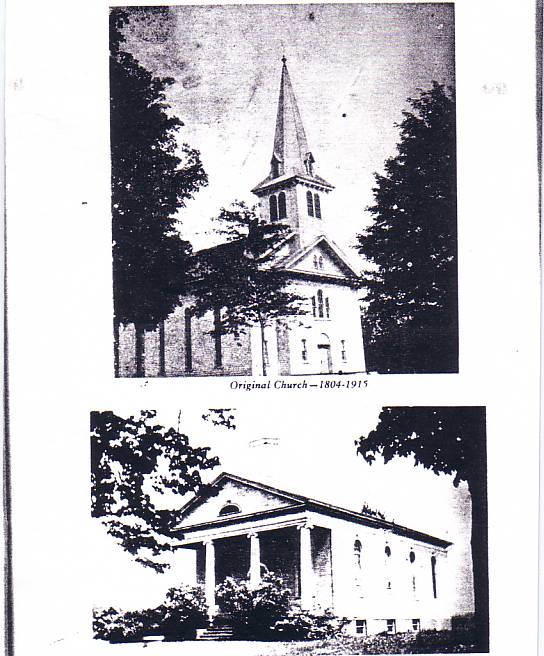
present Church (1917)
Daniel L. Kirtland family. Mrs. Anna Hogarth Young presented the
cornmunion service in memory of her father-in-law, Rev. A. T. Young,
our pastor from 1861 to 1874. The Bible was the gift of Mrs. W. W.
Hopkins, in honor of her mother, Mrs. A. T. Young. The set of brass
cross, candlesticks and vases, now on the communion table, is a recent
gift in memory of elders William Fisher and Howard Skuse. The
hallmarked pewter collection plates, still used weekly, are the
original ones from the old church building.
WORKERS FOR THE CHURCH
There are yet many to speak of. Sylvanus Burtis, great-uncle of the
present Burtises was leader of the early choir many years. Eliza Sayre,
beautiful daughter of Cooper Sayre, is said to have had a particularly
lovely soprano voice. Other choir members were the Ambrose VanDeusens
and Mr. and Mrs. A. J. Weston. Mrs. Weston was also volunteer church
organist, as was Miss Adelaide Cross for years. Leaders in the later
choir were Miss Mary Kirtland and Miss Anne Peck, who not only sang but
tutored at least one of our pastors in his Greek. Faithful Sunday
School teachers were Mrs. Dillingharff, Mrs. Harry Day, the Misses
Kirtland and Mrs. A. J. Weston. Miss Mary Kirtland taught the primary
class for 50 years; Mrs. Raymond C. Ross succeeded her, continuing in a
long term of service. Mrs. Wm. H. Doolittle (Frances) and her sister,
Isa Bruzee Alfred, were enthusiastic leaders in work with young people.
Miss Elva Reed and Miss Lillian Weston, church treasurers, deserve much
more than a mention; Miss Weston held the office 22 years. Many
remember the dollar socials and strawberry festivals lighted by
swinging Japanese lanterns. Our traditional chicken pie suppers were
managed year after year by Mrs. George Chase (Anna Day Chase), then by
Mrs. Myron Willson for a long period; Mrs. Herbert A. McCallum has just
turned over her direction to other capable hands. Among those no longer
in our church, we remember Mr. and Mrs. Nathan Oaks 2nd, J. Seymour
Doolittle and his brother Will, sons of Rev. Henry Doolittle. Seymour
Doolittle was for 69 years an elder of this church; during his lifetime
he occupied every possible church position, even preaching on a number
of occasions. He was author a book on phrenology when that was a
generally accepted science. He experimented with foods, becoming a
vegetarian; he is credited with having made the first successful peanut
butter. Though a versatile man, his first interest was always the
church. He died in 1947, at the age of 92. Two nieces, Mrs. Katherine
Angevine and Mrs. Margaret Wallace of Geneva, and two nephews, Rev.
Francis Wallace and his brother Hugh, survive him. I regret that I have
not compiled a complete list of trustees; I wish it were possible to
give sketches of all elders from Caleb Case down to my father, George
F. Cook, present senior elder, who has filled that office for 38 years
and still willingly shoulders many other church responsibilities. He
was Oaks Corners' postmaster and merchant for over half a century,
having retired only a few years ago. Until recently, Howard H. Skuse
and William M. Fisher were valued members and elders; the Fisher family
is our foremost church family. The prime mover behind most activities
of Church and Grange today is Mrs John Chase (Marion Fisher Chase),
whose enthusiasm, capabilities and devotion to duty are noteworthy. She
is a graduate of Auburn's School of Religious Education, a department
of the Theological Seminary. Daughter of elders, Marion is following
faithfully her parents' example. She is at present choir director and
church organist, succeeding Mrs. Howard Steele in the latter service.
At least five men have gone out from our church as ministers. Rev.
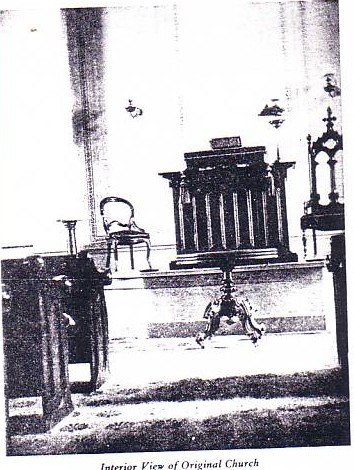
William Young and Dr. Conway Wing belong in the very early years. I
quote from one of Rev. Richardson's historical sermons: ~ 1860, elder
William Young had left. He had been leader in the prayer meetings and
Sabbath School superintendent besides. He later became a minister and,
in that capacity, served a number of churches in Lyons Presbytery". He
was a son of Nancy Pullen Dickinson Young; my proof for this statement
lies in the following sentence from one of Philomela Cooper Wright's
letters:
"Cotten Dickinson 2nd, Rev. Wm. Young and Mrs. Hugh Boyd were
grand-children of Nicholas Pullen". Dr. Conway Wing, pastor of a
Carlisle, Pennsylvania. church for years, was a son of our very early
elder, Enoch Wing. Please notice ~is first name, probably given by a
mother 'homesick for her old New England village. We were proud to have
three of the church's sons participate in the sesquicentennial
observance. They were Dr. Frank Morey Weston of Rochester, Rev. G.
Howard Mickelsen of Trumansburg and Rev. Howard A. Webster of Boyne
City, Michigan. Dr. Weston is a graduate of Hamilton College and Auburn
Theological Seminary. His first pastorate was at Ellicottville. After
several years as pastor of Brighton presbyterian Church at Rochester,
he accepted a call to Geneva's First presbyterian Church. After 7
years, he left Geneva to become Executive Secretary of the Rochester
Presbytery; he retired a few years ago. Lifelong friends the Revs.
Mickelsen and Webster graduated together from Hobart College; the
former is a graduate of Auburn Seminary, the latter of Rochester
Divinity School. Rev. Howard Mickelsen's son, the Rev. John K.
Mickelsen, is now doing home missionary work at Carragana,
Saskatchewan, Canada--his first charge. The son of Rev. Howard Webster
is a pathologist on the staff of Ann Arbor Hospital. The Rev. Francis
Wallace of St. Albans was once closely associated with our church
through his uncle, Seymour Doolittle; he graduated from Cornell
University, took his master's' degree work at the University of Maine
and his theological training at Union Seminary, New York City. His son,
John Wallace, is at present a divinity student at the same seminary.
Miss Lena C. Mickelsen, a sister of Rev. Howard Mickelsen, attended the
Auburn School of Religious Education, was for many years secretary for
the Buffalo-Niagara Presbytery and Is now secretary of Geneva's First
Presbyterian Church. The Presbyterian Church of Atlanta, New York, was
founded July 22, 1894, through the efforts of Mrs. Hyatt C. Hatch
(Edith Armstrong Hatch), sister of Mrs. Ross and Miss Armstrong; the
Atlanta Church has sent out seven ministers from its membership.
With the preceding account of accomplishment, we
close this review of the Oaks Corners Church and community. May our
church continue to render service to God and man for many years to
come, long after its bicentennial in the year 2004.
NOTES
The material in this pamphlet has been enlarged somewhat since given
orally at the sesquicentennial observance; there are more details, but
the main body of information is the same. This is by no means a
complete record. Some families are omitted from the account perhaps
unjustly; such omissions are in general, names which have disappeared
altogether from the area so that their mention would be meaningless to
readers. As an example, consider the Webster family. Armenia Burtis, a
sister of Sylvanus, years ago became the wife of Elder Isaac Catlin
Webster, who lived on the Arthur Day farm after Joseph Hall had left
it. Peculia Webster, a niece of James, was one of Oaks Corners' first school teachers. These are matters of
some interest but the name Webster is no longer with us although Rev.
Howard Webster of Michigan is a great-grandson of the pioneer James.
This history may contain inaccuracies or half-truths,
but, to the best of our knowledge, it is as accurate as the records
which are its source. Certain branches stemming from the church have
been slighted-mission bands, Sabbath school, midweek prayer meetings,
Christian Endeavor and Ladies' Aid Societies. However, the roots and
trunk of our church tree of life have been examined and reported on
with a sincere attempt at thoroughness and appreciation of our
indebtedness to all church workers, each one of whom should be
eulogized. The reason for stressing the earlier years at the expense of
the later should be obvious--the later the
history,, the larger the number of those already familiar with it.
One impression arises from this review of the history of the church,
the spiritual influence that has made it a strong power for good in the
community. Though often weak in numbers and material resources, it has
been strong in faith, with sufficient dedicated members to carry its
work forward, the results of that work impossible to measure. Today, In
this uncertain world of ours, the 150 year old Presbyterian Church of
Oaks Corners, with Rev. William H. McKlrdy as pastor, is holding its
own.
CORRECTIONS AND OMISSIONS
The Cotten Crittenden whom I have said taught in the session room
school was also the Oaks Corners Academy's main teacher for some time.
He later taught in Seneca Falls, Newark and Rochester, also holding
several important librarian positions in Rochester before his death
there in 1880.
The early name of Cotten was usually spelled with an e, not an
o, in the second syllable. Our forefathers
were quite casual about spelling, even of family names. The name Oaks,
for instance, has gone through the following changes: Noak, Oak, Onke,
Oakes, Oaks, VanderMark was most frequently spelled in this way
although sometimes written with a large D and a small m; there was a
difference, too, in the spacing between syllables. Today the first r is
usually omitted, and no capitals are used after the first one. In the
old cemetery, different stones of the Dickinson family show Cotten
spelled in both ways. Thaddeus Oaks, too, is spelled there with one d
as well as with two.
It is interesting to know that the hallmark on the pewter collection
plates, already mentioned, was recently identified as that of Daniel
Curtiss. of Albany, who worked there from 1822 to 1850. Some letters of
his name are now illegible, but the elaborate urn below the name proves
his work.
Undoubtedly, some man of the church planning a business trip to
Albany was commissioned to buy the plates for our society. There is some doubt as to the fate of the old communion set;
it may have been burned in the church fire or may lie forgotten in a
dark closet corner. I am told that one member of the old church was
often careless as to the disposition of his long mustache when taking
communion. As the ends trailed down into the large common goblet, he
would drink deeply, then, wiping the mustache and sighing with
satisfaction, would pass the cup on to his neighbor as he bowed his
head In prayer. Hands sometimes grasped the rim of the shared goblet
Instead of its stem. It is a matter for
wonder that Oaks Corners was not in a state of frequent epidetnic.
However, at those earlier communion services the ancient spirit of
reverence was surely present, if not the modern spirit of sanitation.
A statement made in the oral church history concerning Nancy Pullen
Dickinson was incorrect. Miss Mabel Dickinson of Jersey City, a
great-granddaughter of Cotten Dickinson 1st, has written us the
following facts: Nancy Pullen was the daughter, not the widow (as I had
said), of Nicholas Pullen who settled at Oaks Corners in 1791. Cotten
Dickinson was her first husband, not her second; the couple had eight
children when Cotten was killed at the church raising. Their ninth
child, Cotten 2nd, was born shortly after his father's tragic death.
That part I had retold correctly; the rest of Miss
Dickinson's family story is new. Nancy Pullen was a very pretty girl
and is said to have had her choice of three men as possible husbands.
She chose Cotten Dickinson, as we know, refusing William Young and a
doctor whose name has been forgotten. In all probability, he may have
been Joel Prescott 1st. After she became a widow, she married William
Young, whom she had rejected some years before, and, as Nancy Young,
she had four more children. One of these children became an elder in
our church and later a minister in Lyons Presbytery. I have checked
names and dates in the cemetery. The stones of Cotten Dickinson 1st,
William Young and Nancy Young, his wife, are in the same row, identical
in shape and design of urn with weeping willow. Nancy Young survived
her second husband by ten years.
In connection with the War of 1812--this past
summer two small boys discovered a nest of five cannonballs, 2.5 inches in diameter, buried under debris in the
old woods. Ontario County recruited a regiment for the War of 1812,
commanded by Philetus Swift of Phelpstown; at that time the field east
of our church was used for military training. There is some belief that
these cannonballs may very possibly have been used in maneuvers held in
this vicinity 142 years ago. It is at least an interesting conjecture.
The Thomas Jones farm (mentioned in the Skuse family sketch and now
known as the Howard Skuse farm, Carter Road) was sometimes an
unscheduled stop on the early Auburn branch of the New York Central.
The well-authenticated story is that Miss Lucy Hemiup of Geneva, a
cousin of the Joneses, occasionally came out from town for a day's
visit. When she boarded the train, she would tell the trainman she
wished to get off at the Jones place--and she
did. On hearing the late afternoon eastbound train approaching, Miss
Hemiup would saunter out to the track behind the house, wave her
parasol or handkerchief as a signal, and the train with its woodburning
engine would obediently slow to a stop. Later, she must have been quite
annoyed to find that she was expected to ride some distance past the
Jones farm and descend from the train at Oaks Corners station. Many
residents remember when 14 passenger trains made daily stops at our New York Central depot. Now there are only two. The
Lehigh Valley Railroad, also, maintained a depot and agent at Oaks
Corners for years, with excellent train service.
The Indian Carpet has been mentioned in this booklet but not explained.
Situated on the Nathan Oaks farm, it covered more than an acre of
ground now quarried by the crushed stone plant. Symmetrical rows of
rectangular rocks averaging 5 by 8 feet in dimension, were laid in
geometrical exactness rather like a checkerboard. The stones, about a
foot above ground, were rough on top with fossilized forms similar to
snakes, lizards and honeycombs; they resembled a level graveyard with
all its stones lying prone in rows, separated by grassy spaces about 6
inches wide. Family tradition says that, many years ago, Indians
occasionally visited the spot to hold ceremonlals, and the stones did
cover the ground like a patterned carpet-hence the picturesque name, we
may suppose. The front page of a Geneva newspaper of 50 years ago
carried an extravagantly imaginative article about the carpet. The
reporter thought the formation must be a relic of the pre-Columbian civilization. I quote from the original
clipping before me. "The rocks laid with human precision may be the
foundation of King Solomon's Temple. The formation certainly antedates
the dungeoned medieval castles, the fall of Jerusalem and possibly the
Hanging Gardens of Babylon. The records of the past will never be
complete until the Indian Carpet at Oaks Corners is given the same
attention as the pyramids of Egypt or the buried city of Pompeii. The
discoveries may indicate that Oaks Corners was once the center of a
civilization that may rival that of the Incas of Peru or the much
vaunted culture of Athens, Delphi and Rome". Later the Carpet was
believed to be an Indian burying ground. Still later, geologists
declared it a natural formation. My own guess is that, the severe
earthquake of 1663 may possibly have caused the even fissures in a
hither-to solid mass of stone. Jesuit missionaries recorded this
earthquake as having visited Canada, western and central New York in
that year. The preceding information is from Turner's History of the Phelps and Gorham Purchase. My husband believes the
action of frost is a practical explanation for this one-time
phenomenon. He has been of great assistance in furnishing details of
information for this pamphlet.
West of the Indian Carpet were the Camp Meeting Woods, now nearly gone.
The original stand of 40 acres was a maple sugar bush worked almost
continuously by the Oaks and Hotchkiss families for over 100 years. 300
trees, on an average, were tapped yearly.
The story of the first marriage In the Town of Phelps is told in
various histories, but I should like to retell it here. The bride was a
daughter of Seth Reed, the groom Joseph Annin, afterward Judge Annin.
Thomas Sisson, Esq., Seneca Town Clerk and Justice of the Peace, acted
as minister. The bride's father opposed the marriage and had forbidden
Joseph's entering the house. However, one evening at twilight, he
"happened" to pass by with Squire Sisson; Miss Reed, milking the family
cow conveniently near the roadway, put her pail aside and stood with
Joseph under the boughs of a nearby apple tree while they were solemnly
and legally made man and wife. The men then went on their way, while
Mrs. Annin finished milking the cow that Miss Reed had begun. The
bride's mother may have been an Oaks Corners girl, Doratha Oaks Reed, a
daughter of Jonathan Oaks--or possibly the
bride was Seth Reed's daughter by a previous marriage. We cannot know.
Residents of the township who are interested in its colorful past
reailze their indebtedness to Helen Post Ridley for her invaluable
booklet, "When Phelps Was Young". To my knowledge, it is the only work
of its kind on the early history of this area. I regret she is no
longer living, that I cannot express to her my own enjoyment of her
book and confess my use of it in this pamphlet. The sesquicentennial
observance of the Oaks Corners Church has renewed demand for the few
remaining copies of her book and recreated general interest in the
history of Pheips Township.