This By Frank W. Cook as told to him by Lemuel Cook.
Lemuel Remembers Washington
This By Frank W. Cook as told to him by Lemuel Cook.
Lemuel Remembers Washington
I saw General Washington a few times, said a few words to him and he
back to me. I'll not forget. First time I set eyes on him was at White
Plains or thereabouts. I'd joined up at the first call and those first
couple of years were hard ones. Our company was resting near White
Plains after being pushed off the Island and out of New York City and.
up River. My job was with Major Tallmadge, being in the Light Dragoons
we had horses to take care of. Mine was a good ole Bay I'd brought from
home. I was caring for my horse and a couple of others that needed
rubbing down and heard a commotion a ways down the road. I could see by
the uniforms it was officers leading several company's of Foot. One
fellow sat in the saddle head and shoulders above the others. I knew he
must be the General, we had heard how large a man he was. As they came
closer all I could do was stand there with my mouth open. An officer in
front gave me a dirty look like to be saying, "How Come you don't
salute?" I whipped off a good fancy one. The officers dismounted and
went to talk with the Major I suppose. I went back to my horse, a while
later the General came around the headquarters where I was, to stretch
his legs I suppose and said, "Is that your horse soldier?" "Yes, Sir",
said I coming to attention. He put me at ease and asked my name,
"Lemuel Cook, from Connecticut, Sir". "That's a right smart mount you
have there Lemuel Cook from Connecticut". "He's done good by me,
General" said I. "Well, you take care of him, you will be glad you
did", with that the General went about his business. That's all there
was to it, I'll never forget though, all the things that must have been
pressing on him he took time for a kind word. He had the kindest look
in the eyes I've ever seen. Got the chance to see him a few times more
being in the quartermasters, they called us artificers in them days.
Didn't see him again until some two, maybe three years later. We were
going down thru the Head of Elk, things were better, we had been
winning we knew we had a big battle coming up somewhere to the south.
Scuttle butt was that the General had gone on ahead and would meet us
along the way. Ws had stopped and I was minding my own business paying'
no mind to no one when I heard a rich full voice say, "Lem Cook, is
that you?" "I thought that might be you with that Bay." I had whirled
around with my eyes bugging out and mouth wide open again, amazed that
he had remembered me. I finally managed a "Yes Sir", "It's very good to
see you Sir". "I admire the lines of your Bay, Lem, I have one like it
at Mount Vernon," "Yes Sir, he's a little worse for wear but I've been
keeping.' your advice, my brothers made me promise to bring him back to
the farm when there was done." 11That's what
we are about, Private" and with that the General was gone as quickly as
he appeared. I'd grow~ six inches since last time we'd met, he must
have recognized the horse than me. It seems as though he still towered
a foot over me. But I was ten. feet tall after that, they all asked
"How come the General knows you?" they all asked. I didn't tell 'them.
We saw him again at Yorktown, which turned out to be the big one where
we was heading. Last time I spoke to him was at Danbury when he gave me
my discharge, I was standing there with my brother, still have my'
discharge here someplace, but will have to tell you about that another
time. The General had a look about him you don't forget, there's hardly
any words to describe him. Those were hard days for the most part but
there was some good things about them too.
LEMUEL COOK Was born at his Father's farm in
Northbury the eighth of nine children. Only five survived due to an
epidemic that hit the family, the year Lemuel was born. It is not known
but it is thought that his father received a part of the real estate
that Henry III held at Northbury. It is known that they jointly owned a
hundred acre section. In any event the family remained in the Thomaston
- Plymouth vicinity and that the family were members of the First
Congregational Church of Plymouth, which had been founded by Lemuel's
grandfather, which was then called the Northbury Society. When Henry 4
died the family was left in depressed circumstances, but through it all
the family remained together. Hannah became the guardian for True,
Lemuel and Mary. Selah was only 16 but was apparently able to take care
of himself and to contribute to the well being of the family. At the
outbreak of the Revolution in 1775 Lemuel was the first of the Cook
sons to enlist, Selah the second in 1776 and served for six months and
returned to Northbury and then reenlisted in 1782 for 3 years,
Trueworthy enlisted in 1777 and served for 3 years returning to
Northbury to care for his mother while the other two fulfilled their
service to their country. Seleh also remained at the farm during the
period that True and Lemuel were fighting so that there was someone
always at home to assure that the family was well looked after.
Lemuel served for the entire war and he was wounded several times but
never seriously enough to keep him out of the thick of it for any
length of time. Having received his discharge at the close of the war,
Lemuel returned to Northbury where he married Hannah Curtis in 1783.
They remained in Connecticut for several years and about 1788 the
family came to Clinton, Oneida County, New York, where Lem later
received 100 acres of Bounty Land for his service during the war. His
brothers also came to Clinton, it is known they were first settlers of
the town in 1788, their mother was also among the group that came with
the Plymouth Congregational Society, as they are all mentioned in the
early church records at Clinton during the first year of settlement.
Lemuel and his family, for some reason returned to Plymouth before 1795
as he was one of the incorporators of the Village of Plymouth that
year, changing the name from Northbury. He remained in Connecticut
until 1804 when he returned to New York. The family settled at Pompey
in Onondaga County. Both True and Selah had also emigrated there with
their families before 1795, and here again they were first settlers of
the town where they both purchased large tracts of land. True later
went north to Granby Center, N.Y. where he died in 1822, nothing
further is known of Selah it is thought that he remained at Pompey.
Lemuel purchased a farm of 60 acres which had originally been part of
True's holdings. The farm was in the Military Tract at Pompey at the
southern edge of the Indian reservation and was located a short
distance north of the village on the Henneberry Poad. He was successful
in operation of the farm for a number of years. In 1818 he applied for
his first pension, his wounds had begun to make it increasingly
difficult for him to perform the hard labor required in the operation
of the farm, particularly a farm as large as his and his younger sons
then living with him were not yet old enough to be of much assistance
to him. Both Lemuel Jr. and Miles were also residing at Pompey at this
time, they undoubtedly were able to help their father to some extent,
but they had farms and families of their own to take care of making it
difficult to extend the extensive assistance which was obviously
necessary. In 1821 Lemuel sold the farm at Pompey and came to North
Bergen in Genesee County where Curtis had emigrated a few years before.
Curtis was as yet unmarried and had come to western New York with
Richard Brown and his family and had helped him carve out an existence
in the wilderness, they were the first white settlers at Byron. With
the help of Curtis as they apparently pooled their efforts until 1824,
when Curtis married , Lemuel's youngest sons Gilbert and Saleh were
then able to be of great assistance to their father in the operation of
the farm and they did quite well and prospered. In 1828 Lem purchased a
section of Curtis' first farm and he also owned other large sections at
North Bergen. About 1832 the family removed to Clarendon a short
distance north an west of the farm at North Bergen, where Lemuel was to
remain the rest of his life. Gilbert married and Selah remained with
his dad and between the two all did well at Clarendon. Elm's farm
reached 100 acres and was located on the South Holley Road at the
southeast corner of the Munger Road. The farms of his sons and
grandsons were also located very near and abutted Lemuel's last farm.
After the death of his first wife Lemuel married again, his wife Ruth
was a former resident of Monroe County in the town of Sweden before her
marriage.
Lemuel and Selah worked the farm until 1851 when Selah decided to try
his hand on his own in Michigan and removed to Flint in Genesee County.
Lemuel retired from farming shortly thereafter and sold the farm to
Rathburn Tousley his grandson, who helped Lem after Selah left and
continued to operate the farm for a number of years before he emigrated
to the Dakota Territory. Lemuel remained at the farm until 1860 when
his wife died and abided by the wishes of his sons that he should take
life easy after nearly 80 years of farming. He divided his time between
Gilbert and True who took care of him during his declining years, and
often walked to Clarendon with the help of a cane he was then obliged
to use to pick up his pension, and to see that his grandsons and great
grandsons held of his exploits in the war and among the Indians which
he always enjoyed recalling.
From 1818 until the day he died Lemuel remained on the pension rolls,
in 1828 his stipend allowance was increased to $l00 per year, in 1855
he received an additional 60 acres of Bounty Land which he used for
acreage at Clarendon. Under pension laws passed by Congress in 1864 and
1865 he received $200 and $500, which he received the last year of his
life. There can be no doubt that he was on the pension rolls longer
than any other veteran of the Revolutionary War. He remains the oldest
resident ever to have lived in Orleans County. It has long been kown by
the family and a generally accepted fact that he was the Oldest
Survivor of the Revolution and that he was the Last of the survivors
that were on the rolls with him, the closest being at least a year
younger.
By 1840 all of Lemuel's children had also emigrated to western New York
and to Clarendon, the family can now be found all over the United
States and several parts of the world. All of whom can trace their
family line to a small country village in western New York to a proud
determined individual who has left us an extremely rich heritage. The
place where he rests is in the small family cemetery where the peace is
broken only by the wind in the trees and an occasional visitor, time
may obliterate the monument of stone marking his passing but can never
diminish the monument to his memory which is in each of us.
LAST SOLDIERS OF THE REVOLUTION
by ELIAS BREWSTER HILLARD 1864
Interview With LEMUEL COOK Surviving Dragoon
Of all the men who had marched with Washington. and Arnold, with Gates
and Greene and Mad Anthony Wayne, only seven were still alive. All were
past 100 years, the eldest, Lemuel Cook was 105 years of age.
Lemuel Cook is the oldest survivor of the Revolution. He lives in the
town of Clarendon, Orleans County, New York. His age is 105 years. Mr.
Cook was born in Northbury, Litchfield County, Connecticut September
10th 1759 the son of Henry Cook and a grandson of the first settler of
the town also named Henry Cook. He enlisted at Watertown when only
sixteen years old. He was mustered in at Northampton in the Bay State
2nd Regiment of Light Dragoons in the command of Colonel Elisha Sheldon
in the Company of Captain William Stanton. He served throughout the war
and was discharged at Danbury, Conn. June 12, 1783. The circumstances
of his service he relates as follows?
"When I applied to enlist, Captain Hallibud told me I was so small he
could not take me unless I would enlist for the war. The first time I
smelt gun powder was at Valentine's Hill (Westchester, N.Y. Oct 1776).
A troop of British horse were coming, 'Mount your horses in a minute',
cried the Colonel. I was on mine as quick as a squirrel. There were two
fires-crash! Up came Parrow, good old soul, and said, 'Lem, what do you
think of gunpowder? Smell good to you?'
The first time I was ordered on sentry was at Dobb's Ferry. A man came
out of a barn and leveled his piece and fired. I felt the wind of the
ball. A soldier near me said, 'Lem, they mean you, go on the other side
of the road.' So I went over, and pretty soon another man came out of
the barn and aimed and fired. He didn't come near me. Soon another came
out and fired. His ball lodged in my hat. By this time the firing had
aroused the camp and a company of our troops came on one side, and a
party of the French on the other and they took the men in the barn
prisoner and brought them in. They were cow boys. This was the first
time I saw the French in action. They stepped as though on edge. They
were a dreadful proud nation. When they brought the men in, one of them
had the impudence to ask, 'Is the man here we fired at just now?'
'Yes,' said Major Tallmadge, 'There he is, that boy.' Then he told how
they had each laid out a crown and agreed that the one that brought me
down should have the three. When he got through with his story, I
stepped to my holster and took out my pistol, and walked up to him and
said, 'If I've been a mark to you for money, I'll take my turn now. So,
deliver your money or your life! He handed over four crowns and I got
three more from the other two."
Mr. Cook was at the Battle of Brandywine (September 11, 1777)
and at Cornwallis' Surrender (October 19, 1781). Of the latter he gives
the following account :
"It was reported that Washington was going to storm New York. We made a
by-law in our regiment that every man should stick with his horse, if
his horse went he should go with him. I was waiter for the
quartermaster, and so had a chance to keep my horse in good condition.
Baron Steuben was mustermaster. He had us called out to select men and
horses fit for service. When he came to me he said, 'Young man, how old
are you?' I told him. 'Be on the ground tomorrow morning at 9 o'clock'
said he. My colonel didn't like to have me go. 'You'll see,' said he
'they'll call for him tomorrow morning.' But they said if we had a
by-law we had to abide by it. Next morning old Steuben had got my name,
there were eighteen out of the regiment, 'Be on the ground' said he
'tomorrow morning with two days provisions.' 'You're a fool,' said the
rest, they're going to storm New York.' No more idea of it than going
to Flanders. My horse was a bay, and pretty. Next day I was the second
on parade. We marched off towards White Plains. The 'left wheel' and
struck right north. Got to King's Ferry, below Terrytown, there were
boats, scows, etc. We went right across into the Jerseys. That night I
slept with my back to a tree.
Then we went to Head of Elk. There the French were. It was dusty,
'Peered to me I should have chocked to death. One of 'em handed me his
canteen, 'Lem,' said he, 'take a good horn, we're going to march all
night.' I didn't know what it was, so I took a full drink. It liked to
have strangled me. Then we were in Virginia. There wasn't much
fighting. Cornwallis tried to force his way north to New York, but fell
into the arms of LaFayette, and he drove him back. Old Rochambeau told
'em, I'll land five hundred from the fleet against your eight hundred.'
But he darnst. We were on kind of a side hill. We had plenty little to
eat and nothing under heaven to drink. We hove up some brush to keep
the flies off. Washington ordered that there should be no laughing at
the British, said it was bad enough to have to surrender without being
insulted. The army came out with guns clubbed to their backs. They were
paraded on a great smooth lot, and there they stacked their arms. Then
came the devil-old women, and all (camp followers). One said, 'I wonder
if the damned yankees will give me any bread.' The horses were starved
out. Washington turned out with his horses and helped them up the hill.
When they see the artillery, they said, 'There, them's the very
artillery that belonged to Burgoyne.' Greene came across from the
southward, the awfulest sight you ever see; Some I should presume had a
pint of lice on 'em. No boots nor shoes."
The old man's talk is very fragmentary. He recalls the past slowly, and
with difficulty, but when he has his mind fixed upon it, all seems to
come up clear. His articulation also, is very imperfect, so that it is
with difficulty that his story can be made out. Much of his experiences
in the war seem gone from him, and in conversation with him he has to
be left to the course of his own thoughts, inquiries and suggestions
appearing to confuse him. At the close of the war he married Hannah
Curtis of Cheshire, Conn. and lived a while in that vicinity, after
which he removed to Utica, New York. There he had frequent encounters
with the Indians who still lived in the area. One with whom he
had had some difficulty over cattle assailed him at a public house, as
he was on his way home, coming at him with great fury, with a drawn
knife. Mr. Cook was unarmed, but catching up a chair he presented it as
a shield against the Indians thrusts until help appeared. He says he
never knew what fear was, and always declared that no man would take
him prisoner alive. His frame is large and his presence commanding, and
in his prime must have possessed prodigious strength. He has evidently
been a man of most resolute spirit, the old determination still
manifesting itself in his look and words. His voice the full power of
which he still retains, is marvelous for its strength and volume.
Speaking of the present war, he said, in his strong tones, at the same
time bringing down his cane with force upon the floor, 'It is terrible,
but terrible as it is the rebellion must be put down'. He still walks
comfortably with the use of a cane, and with the aid of glasses he
reads his book, as he calls his Bible. He is fond of company, loves a
joke and is good natured in a rough sort of way. He likes to relate his
experiences in the army and among the Indians. He has voted democratic
since the organization of the government, supposing that it still
represents the same party it did in Jefferson's time. His pension,
before it increased, was one hundred dollars. It has now increased to
two hundred dollars. The old man's health is comfortably good and he
enjoys life as much as could be expected at his great age. His home at
present is with a son whose wife, especially seems to take kind and
tender care of him. Altogether he is a noble old man, and long may it
yet be before his name shall be missed from the rolls of his country's
deliverers. -Elias Brewster Hillard.
This piece has been published several times in various forms. The
original author's manuscript is at the New York State Library at
Albany, which also included two pictures of Lemuel.
Copy
of Article in Rochester Union Advertiser May 22, 1866
LEMUEL COOK - THE LAST
REVOLUTIONARY PATRIOT AND PENSIONER - DEAD
Lemuel Cook, who is
believed to be the last of the Revolutionary heroes and pensioners,
died at Clarendon, Orleans Co. New York on Sunday evening, the 20th at
the home of his son True W. Cook.
Mr. Cook according to his own statement was born in Plymouth,
Litchfield County, Connecticut. The year of his birth is uncertain, but
from statements made to the writer some years ago, when his mind was
unimpaired, he was probably born in 1764. He was about 17 years old
when he entered the service of his country in the spring of 1781.
A writer for the New York Herald, in giving a sketch of the surviving
Revolutionary pensioners on October 10, 1863 states that, "He enlisted
for the 2nd Light Dragoons, Col. Sheldon, but was mustered into
Stanton's company of infantry, and continued in that company and in the
service of the United States until June 1783, when he was, at the
termination of the war, discharged at Danbury, Conn."
He has retained in his possession a copy from the War Department of his
discharge, signed by George Washington, which states that he was a
private in the 2nd Light Dragoons, Conn. Regiment. His field officers
were stated as Col. Sheldon, Lieut. Jennison, and Major Benjamin
Tallmadge.
The date of discharge is the same as stated in the Herald, it winds up
as follows; The above named Lemuel Cook has been honored with the badge
of merit for three years faithful service."
Soon after entering the service, Mr. Cook marched with the army to that
memorable campaign in Virginia,. and was at the closing struggle at
Yorktown, and witnessed the surrender of Cornwallis on the 19th of
October 1871.
Mr. Cook moved from Conn. to Oneida Co., New York, thence to Bergen,
Genesee Co. and from the latter place to Clarendon, N.Y. where he has
resided for about 30 years.
Mr. Cook was a life long Democrat in his politics, and until within a
few years ago was punctual in his attendance at town meetings and
elections. He continued to write his name to orders and pension papers
until the last winter when he became to enfeebled to write. His
autograph has been sought for from all parts of the country. In the
spring of 1861 a Hartford publisher sent an artist to procure his
photograph, the first and only one that has been taken of him and the
picture is remaricably correct.
Among the last autographs is one now in the possession of the Bureau of
Military records at Albany, furnished at the request of Mr. Doty.
According to the statement of the Herald, there was on the twelfth of
March 1861 12 surviving Revolutionary pensioners in the southern
states. (This has now been proved to have been entirely false.)
The funeral will take place tomorrow at 10 in the morning in a grove
near the house of his son, Curtis Cook, if pleasant, in the south east
corner of Clarendon. As 'Ir. Cook was a Mason he will be buried under
its honors as well as those of war, the Rev. Col. James T. Fuller has
been sent for to officiate as chaplain of the ceremonies which will be
attended to the burial of the Last Survivor of the Army of the
Revolution.
Clarendon, May 22, 1866 -George M. Copeland.
There are several false statements made in this piece, but it is the
most nearly correct of any of the articles published at the time of
Lemuel's death.
The following piece appeared in the ORLEANS REPUBLICAN May 24, 1866
Lemuel Cook Sr, the last of the Revolutionary heroes, died on Sunday
night in Clarendon, N.Y at the age of 107 years. He was born in
Plymouth Conn. and at the age of 16 years he entered the Army of the
Revolution, first in the Dragoons and then in the infantry under
Colonel Sheldon. Mr. Cook in the second enlistment served 3 years in
the Army, was present at the surrender of Cornwallis at Yorktown and
took an honorable discharge at the close of the war which was signed by
General George Washington. Mr. Cook came to western N.Y, to reside over
30 years ago. He has been in feeble health for a couple of years past
but up until 1864 was quite active The funeral of Lemuel Cook took
place on Wednesday, none of the churches were large enough to
accomodate the crowd attending so the body was taken to a nearby grove
where he laid in state and the funeral service was held. The masonic
fraternity took charge of the proceedings. The sermon was preached by
the Reverend James M. Fuller, his discourse will be remembered as a
masterpiece, his text taken from the Psalms 44-1 to 3. The burial was
also with military honors at the family cemetery a short distance down
the road.
The following description of the funeral appears in Copeland's History
of Clarendon at page 284
A large procession brought Lemuel from the home of his son True to the
woods across from the farm of his son Curtis, where the funeral was
held. A few boards were placed in front of the speaker, where the
coffin rested, and the large audience seated themselves as best they
could, and for two hours listened to the eloquent words which came
forth in memory of the departed soldier. The text was taken from the
words, "We have heard with our ears, our fathers have told us". This
was the most impressive funeral that ever took place in Clarendon, and
the only one that has ever been held in that most beautiful and grand
of all God's temples, the woods, where the golden pencils of
light came streaming down through the arches of shade in all the
richness of glory and softness of perfect peace and hollowed rest. In
the words of Byron--"He has fought his last fight, He has seen his last
battle, No sound can awaken him to glory again."
-David Sturges Copeland 1888
Mrs. Nettie Cook Smith often spoke of her memory as a little girl
following the funeral procession from the home of True Cook on the
Merrill Road, where Lemuel lived the last years of his life, to the
large wooded section directly across from the farm of Curtis Cook on
the fiunger Road for the funeral, and then on to the cemetery service a
short distance down the road to the west. Nettie was a daughter of
Franklin and grand daughter of Lemuel Cook Jr.
This article -By ROBERT SPENCER
It was
July, 1864. Still another year of agony and desolation faced the nation
divided
by Clyil War.
"It is terrible." Lemuel Cook, 105, of Clarendon, Orleans County, New
York, was speaking of the carnage. "But, terrible as it is, the
rebellion must be put down." And, as though making an exclamation
point, he brought down his cane with force upon the floor.
Lemuel Cook was the oldest of the North's 12 surviving veterans of the
American Revolution. And for a moment, the old determination flared
again and out of his past, out of the present tumult and pain and
pride, came the salty account of another struggle - Yorktown, Oct. 19,
1781, final British defeat in the American War of Independence.
Cook had been with General Washington's army at Yorktown and at
Cornwallis' surrender there. Of the latter, the very old man now spoke,
"slowly and with difficulty" and "his talk broken and fragmentary:"
"We were on a kind. of side hill. We had plaguey little to eat and
nothing to drink under heaven. We hove up some brush to keep the flies
off. Washington ordered that there should be no laughing at the
British; said it was bad enough to have to surrender ... The army came
out with guns clubbed on their backs ... Then came the devil - old
women and all ... The horses were starved out. Washingtcn turned out
with his horses and helped them up the hlll ... Greene came from the
southard; the awfullest set you ever see. Some, I should presume, had a
pint of lice on 'em. No boots or shoes."
Cook's interviewer that summer day in 1864 was the Rev. Illias Brewster
Hillard, a Congregational minister from Connecticut. He was on a long
journey - by rail, stage coach and horse - to visit and photograph the
last 12 pensioners of the Revolutionary War. They lived from Maine to
Missouri.
A strong sense of urgency spurred Hillard on the mission he had
undertaken for N. A. and R. A. Moore, Hartford, Conn., publishers, who
wanted to record the first hand stories and photographs of "The Last
Men of the Revolution." Each man already was at least 100 years old.
Near Rochester lived two of The Last Men: - - Lemuel Cook, of
Clarendon, who had served three years as a private in a Connecticut
regiment, the Second Light Dragoons. Before witnessing Cornwallis'
surrender, he was at Brandywine and in other battles. After the
war he became a farmer near Utica. Late in life he went to live with
his son in Clarendon, five Miles south of Holley.
- - Alexander Milliner, of Adams Basin, Monroe County, about midway
between Spencerport and Brockport. He had been a First New York
Regiment drummer boy for 3˝ years, was at the Valley Forge encampment
and was wounded in the thigh at the battle of Monmouth.
Hillard found that in the Continental army Milliner apparently was "the
life of the camp, could dance and sing, 'nothing troubling him over
five minutes at a time' ... he is small, more so than his picture would
indicate." His enthusiasm never waned. At the outbreak of the Civil
War, Milliner, then 101, wanted to take his drum. and go to Rochester
and beat for volunteers. The drum now is part of the permanent
collection of Irondequoit Chapter, Daughters of the American Revolution.
In the e'arly 1800s Milliner built boats and operated an Erie Canal
dock in Rochester. He died in 1865 at age 105 and is buried in Mt. Hope
Cemetery in Rochester.
Still standing in Clarendon is the 143 year-old house in which Lemuel
Cook lived and where, in 1866, he died at age 106.
Since 1934 the house has heen the home of Clarendon Supervisor and Mrs.
Alvin Hilfiker. They have made many architectural changes in the
building in the last 35 years.
The house is at 16575 Boots Road, near the Byron-Holley Road, in the
southeastern corner of Orleans County.
Hilfiker was elected Clarendon supervisor four years ago.
In 1840, according to the Federal Census there were literally
hundreds of surviving Revolutionary Soldiers on the rolls of our
country's deliverers. The next quarter century would see them all swept
away, all but one. By 1863 there were only 12 Veterans living, Whose
names appeared on the pension rolls and Official records of the Nation.
They passed to their reward in the following order. LAST WILL AND TESTAMENT OF LEMUEL COOK I Lemuel Cook, pf the Town of Clarendon in the County of
Orleans and state of New York, considering the uncertainty of this
mortal life, and being of sound mind and memory, do make publish this
my last Will and Testament, in manner and form following: that is to
say Firstly, I give and bequeath to my eldest son MILES COOK the
sum of one hundred dollars, I also give and bequeath to my daughter
ESTHER COLEMAN the sum of ten dollars, I also give and bequeath to my
son LEMUEL COOK Junior the sum of two hundred dollars, I also
give and bequeath to my son WORTHY COOK the sum of one hundred
dollars, I also give and bequeath to my son LYMAN COOK the sum of
two hundred dollars, I also give and bequeath to my daughter
ELECTA TOUSLEY the sum of ten dollars, I also give and bequeath
to my son CURTIS COOK the sum of two hundred dollars, I also give
and bequeath to my son GILBERT COOK the sum of four hundred
dollars, I also give and bequeath to my grandson EDGAR HOWE the
sum of forty dollars, and I do hereby enjoin upon my son Gilbert
Cook and James M. Hollister, whom I do hereby appoint executors of this
my Last Will and Testament, hereby revoking all former wills by me
made, and that I also give good and sufficient bail that my wife RUTH
COOK shall be supported in a good and decent manner, with all the
necessities of life so long as she shall remain my widow, her support
and living to be amply secured to her before the above legacies shall
be paid, unless in the opinion and judgment of the executors, by and
with the advice of the Surrogate there is amply sufficient real and
personal estate to pay the aforesaid legacy and secure to my wife Ruth
Cook her support and living as aforesaid. And lastly, as to
all the rest, residue and remainder of my personal estate goods and
chattels, lands, tensments of what soever kind and nature I give and
bequeath to LEMUEL COOK Jr., WORTHY COOK, LYMAN COOK, CURTIS
COOK, MILES COOK, GILBERT COOK and ESTHER COLEMAN and ELECTA TOUSLEY,
to be equally divided between them. And my Will is that the above
legacies or bequeathments be paid to the above named persons as soon
after my death as the goods and chattels, real and personal estate can
be sold to good advantage by the executors. Whereof I have
hereunto set my hand and seal this 27th day of April in the year of our
Lord Eighteen Hundred and Fifty Five. LS.---------- Seal Signed sealed published and declared by the
above named Lemuel Cook, to be his last Will and Testament, in the
presence of us, who have hereunto subscribed our names as witnesses in
the presence of the testator.
THOMAS
TEMPLETON
JAMES M.
HOLLISTER
LS. The petition of GILBERT COOK of
the Town of Clarendon in the County of Orleans and state of New York,
respectfully shows: That Lemuel Cook Sr. late of the Town of Clarendon in the said County
of Orleans, deceased, died in
the said town
of Clarendon on or about the Twentieth day of May
in the year of our Lord one thousand eight hundred and sixty-six, being
at that time an inhabitant of
the County
of Orleans; that he died leaving a Last Will and Testament, which
is now produced in the Surrogate's Court of the said County of LEMUEL
COOK Orleans, before the said
Surrogate, which bears the date 27th day of April in the year of our
Lord 1855, and by which said Last Will and Testament the said
deceased nominated and appointed Gilbert Cook and James M. Hollister
executors thereof; that the said deceased died possessed of Real
and Personal Estate in the said County of Orleans; and that the
following named persons are all the heirs at law and next of kin of the
said deceased, and their respective ages and places of residence are as
follows: TRUE WORTHY COOK, MILES
COOK, GILBERT COOK, CURTIS COOK all residing
at Clarendon, Orleans Co., N.Y. ELECTA TOUSLEY, residing in Gaines, Orleans
Co., N.Y. LYMAN COOK, residing in Buffalo,
Wisconsin MERRITT COOK, CHARLES COOK, and
FANNY HAMMOND all residing in Clarendon,
N.Y. HOMER COOK residing in Lake Mills, Wisconsin grandchildren
of the said deceased and children of LEMUEL
COOK Jr. deceased, and EDGAR HOWE residing in
Flint, Michigan grandchild of the said deceased and son of HANNAH HOWE
deceased. The above are all of full age and
the only heirs and next of kin of the said deceased. SPENCER
COLEMAN, SIMEON D.
COLEMAN, JOSHUA COLEMAN
Jr., ELECTA RUYDER, and SALLY HOLMES,
grandchildren of said deceased and children of ESTHER COLEMAN deceased, all of full age and residents of
Clarendon, NY. and that the Real and Personal Estate of the
said deceased will not exceed the sum of $2,000.00.
Dated July 14th 1866 GILBERT COOK
Witnessed by the Clerk of Surrogate Court.
LS. Seal Although the proceedings of probate were
begun by the family there was never any final disposition made by the
court and the will was never probated.
Cook's closest surviving relative is thought to be a great-great-grand
niece, Mrs. Gilbert L. Kishlar of 113 South Main St., Holley.
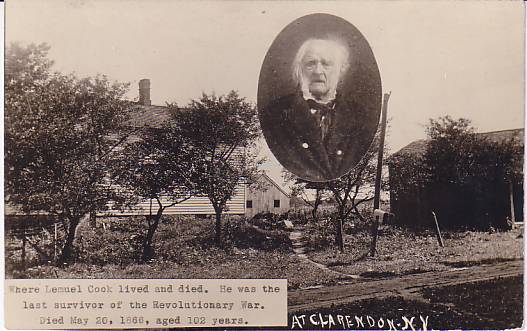
The above post card states his age at death as 102.
==================================================
THE LAST SOLDIERS
- F. W. Cook
Amaziah Goodwin, Alfred, Maine died June 22, 1863 aged 105 years
Benjamin Miller, Albany, New York, died September 24, 1863 aged 100
years
John Goodnow of Boston, Mass. died October 22, 1863 at age 102
James Berman, of Missouri, died January 10, 1864 at 102 years
Samuel Downing, Edinburg, New York died March 16, 1864 aged 102
Jonas Gates, Chelsea, Vermont died March 18, 1864 at 101 years of age
John Pettingill of Henderson, New York, died April 23, 1864 at 99 years
of age
Rev. Daniel Waldo, Syracuse, New York, died July 30, 1864, aged 103
years
William Hutchins of York, Maine, died August 4, 1864 at age 102 years
Adam Link, Sulphur Springs, Ohio died August 15, 1864 at age 103 years
Alexander Milliner, Adams Basin, New York died March 15, 1865 aged 105
years
Lemuel Cook of Clarendon, New York died May 20, 1866 at 107 years of
his age.
Lemuel was clearly the eldest of all of these Last Survivors and he was
without any question the Last Pensioner the last year of his life. In
1867 the 39th Congress gave pensions to two other men by "Special Acts"
in their behalf because they could not meet the criterion of previous
pension laws, they were; John Gray of Brookfield, Ohio who died March
29, 1868, age unknown, who served less than six months; and Daniel F.
Bakeman of Freedom, NY who died April 5, 1869. The only existing
reference to his age is on his headstone which says he wes 109 years,
nor is there any existing record of his service in NY where he said he
served nor in the National Archive., nor record of the testimony given
before the 39th Congress prior to the passage of his Bill. Be that as
it may, while he lived Lemuel was the Oldest and the Last Survivor and
was born before the two that were added to the rolls after his death.
With any distinction there are and have been those who would lay claim
to it, I say let them prove it, if they can, none have yet
succeeded.
There are many Revolutionary Soldiers that appear in our Cook and
related families, we have yet to determine an exact number here are a
few of them.
Selah Cook 1756-1809 Private Ct
Trueworthy Cook 1758-1822 Private Ct
William Tousley Jr. 1761-1827 Private Vt father of Orson and Matilda
Tousley
Timothy Coleman 1752-1831 Lieut. NY father of Joshua Coleman
Jonathan Mason 1733-1771 Lieut Ct grandfather of Susan (Mrs. Lemuel
Cook Jr.)
William Stewart ? NJ maternal grandfather Eva Bird (Mrs. Edgar Howe)
Benjamin Pettingill 1761-1844 Pvt. Mass mater. grandf. Amos P.
wetherbee and father of Mary Pettingill Rice (Mrs. Beckwith Cook)
Daniel Cook 1763-1806 Pvt Mass grandf. of Mary Ann wife of Homer Cook
William Millikin 1752-1808 Pvt NH great grandf. Julia - Mrs. Dallas D.
Cook
Samuel Lewis 1749-1790 Pvt Mass great grandf. of Florence Lewis Harrison
Ebenezer Soul. 1750-1812 Pvt NY grandf. of Martha Jane - Mrs. Joshua
Coleman II
Moses Holmes II ? grandf. of John Holmes II
These are only a few with connecting relationships in the 5th, 6th and
7th Generations there are many many others. There are extensive records
of their service all of it most interesting. As many as 15 soldiers
have been discovered in one family, that number may prove to be
greater. This seems to be the case in many of our families, perhaps
this is coincidence, we cannot know. In any case it is remarkable, and
something we have every reason to be proud and thankful
for. --- F. W.Cook
COPY ESTATE OF LEMUEL COOK FROM THE OFFICE OF SURROGATE FOR ORLEANS
COUNTY PETITICN FOR
PROOF OF WILL.
SELAH COOK, residing in Flint, Michigan All adult children of the said
deceased