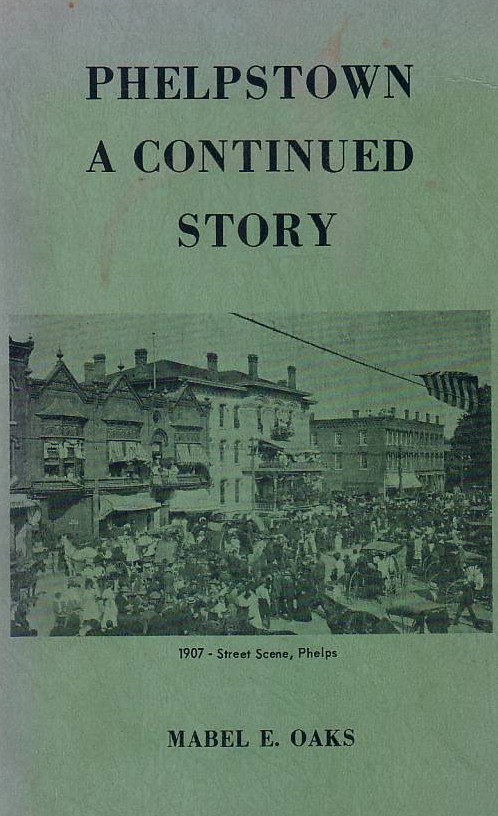
Phelpstown Footprints -by Mabel Oaks
Ontario County, New York
Also
by Mabel Oaks see:
The
Presbyterian
Church of Oaks Corners
If You are
interested in Oaks Corners I am sure you will want to own a copy of
these books. They can be purchased at Phelps Community Historical Society, 66 Main
Street, Phelps, NY 14532. tel 315.548.94940 Summer hours -
May-Aug
Wed- Sat 10 AM-4 PM. Winter (Sept-April) Tues-Fri 10 AM-4
PM. They are
also available by appointment.
The website: http://www.phelpsny.com/phelps-fun/historical-society/
email histsoc@fltg.net
They
also carry books by John Parmelee, Mabel Oaks, and others....
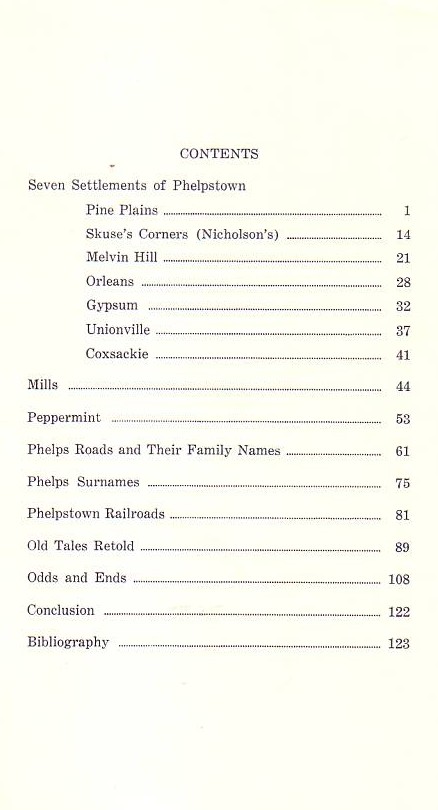
Seven
Settlements of Phelpstown
PINE
PLAINS
"THIS IS THE FOREST primeval. The murmuring pines and the hemlocks - --
- stand like Druids of eld, with voices sad and prophetic." This was
Pine Plains when the first folk came there from the land of the Druids,
England, to make clearings in the wilderness, to build cabins and raise
their families. Boundaries of this area are now much the same as then.
It extends in a rough rectangle from Lyons Road far into Seneca County
to the east. On the north the area begins near Route 96 and ends at
Packwood Road on the south. The pioneer pine plains contained well over
a thousand acres of level, low-lying country, some of it swampy, all of
it darkened by the virgin forest of its pines.
As everywhere, the people of the Pines were good and bad, intelligent
and ignorant, industrious and inert. Isolated as they were, some
intermarried closely, too closely. Their good native stock
deteriorated; their standards suffered. European royalty pursued the
same poor practice for centuries, but for different reasons. It was
said some Pine Plains settlers still had the pallor of debtors' prisons
on their faces. It was no disgrace if they did. Canandaigua's old jail
had its debtors' cell in which luckless local folk were from time to
time confined. Imprisonment for debt seems to have been senseless. How
could men ever pay when they were not allowed to work? Imagine how full
debtors' jails would be now in these days of installment buying!
In time, three small centers of activity formed among the pines-one
near the church on Lyons Road, another on New Pre-Emption Road to the
east, the third on Packwood Road. The little Lyons Road church still
stands, still gives good service although no longer Episcopalian. Once
called the Mission Church of South Phelps, it had no pastor of its own
but was under the care of a larger neighboring church by whom a
preacher was supplied. In the 1870s it was under protection of St.
John's Church, Phelps village. At times it was the protégé' of St.
Peter's, Geneva, whose records include a register of its baptisms.
However, when Frank Mack (formerly of Phelps) wrote of it in 1904, the
church was again under Phelps instruction.
The November 1904 issue of "The Four-Track News, a Magazine of Travel
and Education," nationally circulated, carried Mack's article "In the
Shadow of the Pines." I quote in part: "The little hermit colony has
its church with distinctive wooden cross at the gable. It has known
vicissitudes, and its hearth has sometimes been cold. Its property was
at one time innocently debased when its loft was made storage place for
stolen goods by a band of thieves whose chief lived near the church."
(I could name names, but the articles stolen are of interest too. Fur
coats, fur robes, blankets, harnesses and saddles were hidden there
even young pigs during a short but lively interval.) "The people cling
to their church life, the only thing besides their old English dishes
which came over the ocean with their ancestors." (Mack)
More than eighty years ago a child's murderer struck and was speedily
lynched in the woods just north of the church. The daughter of a member
of the lynching party told me that, as a child, she was shown the rope
still swinging from a tree limb. So lynch law was exercised at Pine
Plains while Episcopalian law was being taught nearby. This is not to
speak ill of the community. Lynch law received its title in
aristocratic, Episcopalian Virginia, which state once had a peace
officer of that name too ready to issue sentences for hanging.
When the little congregation had no pastor, the church was closed. Yet
always it reopened, prayed and worked into longer life by members like
Mary Ann (Smith) Dawkins of Welch Road. Widowed early and poorly
supported by her photographer son, Mrs. Dawkins' chief interest was the
Lyons Road Church. Before coming to the Pines she must have known
better days. Oaks Corners museum has her tiny, hand-tooled leather baby
shoes and framed sampler stitched in 1830 at Mamaroneck, L. I., when
she was thirteen. On it the alphabet is lettered in five scripts. Its
motto advises:
"A sampler resembles a well governed mind
Whose passions by virtue subdu'd and confin'd,
Move only in lines of affection and
duty,
Reflecting a picture of order and beauty."
Treasured by her over the years, these lines may have set a behavior
pattern for Mary Dawkins' life. The museum also has a letter of
sympathy she sent to a friend in 1879; the note is well-written, deeply
religious in tone.
All Pines Episcopalians were not cast in Mrs. Dawkins' mold. One Sunday
when there were to be baptisms, the young rector learned to his dismay
that some babies were children of unmarried couples. He proceeded to
lecture his congregation severely and refused to perform the service.
Finally agreeing to continue, he later wrote a widely-circulated
article on the loose morals of Western New York. As a result he became
disliked, resigned his position and left the area, I am told.
The Pine Plains tollgate house on the Lyons-Geneva plank road was the
first place south of the church, known for years as the Manktlow house.
Toll was taken from a porch-like enclosure attached to the east end of
the house, close by the road. When no longer needed, this enclosure was
made part of the house interior, a bed alcove. Near it rose the quaint
chimney place, its cupboards and oven. Edna Oldacre Fisher, of the
Manktlow family, tells me she saw the old house burn--a few flickers,
one great puff of smoke and flame, and the ancient timbers were gone.
Today the new home of William Paul Tracey stands on the toll house
site. The Charles Fishers, whose Oldacre home is opposite the church,
are an example of contrast between modern Pine Plainers and the early
people. Both have positions in Geneva, have made a half dozen trips by
jet to California and plan to spend their retirement years there. Mr.
Fisher grows lovely orchids as a hobby.
The only other Phelpstown tollgate house known to me is the home of Dr.
Donald Pulver, Clifton Springs Road. In the very center of the house
was a small double-walled room, the toll office (later used as a
pantry) with a wall opening like a cashier's window into the front
hall. Here toll was received. Gates were usually operated from the
house. They say stagecoach drivers would crack their whips to warn gate
keepers to start turning the crank that raised the long bar from the
road. When the Pulvers remodeled, tearing out this room, quantities of
old newspapers were found between its walls--among them a full-length
picture of Abraham Lincoln.
The terms toll road and turnpike were synonymous, and soon tolls made a
popular practice of "shunpiking," driving on back roads. Undoubtedly
thrifty Phelpstown travelers often preferred Carter or New Pre-Emption
Road to the Lyons plank highway, even though the latter was more
improved. There were other ways too of avoiding toll payment. Two women
drivers, stopped at a gate one day, inquired how much the charge was.
The gatekeeper answered, "Fifty cents for a man and a horse." "Well
then, get out of our way; we're two girls and a mare. Giddap, Jenny!"
And away they went. Modern folk sometimes shunpike to avoid traffic,
not toll. The Asheville, N. C., Chamber of Commerce--probably others as
well--even offers a free shunpikimg map of its scenic byways.
Improved though it was, the Lyons plank road must have left much to be
desired. (By 1870 most plank roads had been abandoned because of cost
of upkeep; stringers and cross pieces decayed so quickly.) Low sections
were logs laid closely crosswise--called corduroy, their roughness
revealed by the name. Many years later when Clarence Fynaut was a Lyons
Rd. boy, he sometimes earned a quarter for digging one of these ancient
logs out of the roadbed and refilling the hole with dirt. Sand
teamsters driving from Geneva to the Oaks Corners pit made these
payments.
The small settlement on New Pre-emption, two roac[s east of Lyons Road,
was really the heart of the Pines. At one time it included two
churches, two stores, postoffice and school as well as houses. The 1874
Seneca Co. Atlas shows families named Steele, Butts, Morris, Thayer and
Ridley--among others--living there. Later Cook, Baker and Patrick were
prominent names. A few others were Arnold, Avery, Boyce, Bryant,
Fairman, Gittens, Parish and Taylor.
A two-story schoolhouse stood just north of Lynch's store, corner of
New Pre-emption and Steele Rds. The Jim Steeles bought the building
(then not in use) for their home, tore down the Lynch store and built,
attached to south side of the house, their own store, later run by Will
Patrick and still standing. This business proved unprofitable. Mr. and
Mrs. Steele had their own separate prices for goods, all unmarked, so
that a customer's expenditure depended on which one was tending store.
People were dissatisfied. Soon Jim Ridley erected a second store north
of the White Church. All this was on New Pre-emption Road, the west
side of which is in Ontario County, the east side Seneca County, Oaks
Corners and Pine Plains have in common the unusual fact that each is
bisected by a Pre-emption road, the old one false, the new one true.
Again on the subject of storekeepers--I have learned of one Phelpstown
Shylock whose custom it was to break a bulk cracker in two to measure
one exact pound, not a crumb over. There was also the local merchant
who pressed the scales with his thumb to give less than one just pound.
The Pines' Presbyterian Church--once called the White Church, then
Union--was later used as a community club center. A 4-H group met there
regularly. Now the building shelters only an occasional private party
or wedding reception. The neighborhood's second church was Methodist,
an unpainted wood structure on the east side of the road opposite and
north of the White Church. This was later sold, torn down and its
timbers used in other near-by buildings.
As a little girl, Belle Edington (Spears) regularly attended both of
these churches. From her home on Lyons Rd., now that of Henry D.
Eddington, she walked to Presbyterian Sunday School with her
grandfather along a footpath through the woods to Welch Rd. From here
a wagon trail wound through the big pine woods to reach the New
Pre-emption. In fact, three woods roads converged on the settlement
near the stores. There was no highway east from Lyons Rd., as now at
Mr. Baroody's gas station.
The trip through the trees to Sunday School was sometimes eventful.
One morning the alert grandfather heard a rustle of leaves beside the
path and caught glimpses of a large snake. Breaking a stout stick for a
cudgel, he killed a rattlesnake just as it raised its head to strike.
At Sunday School Belle Edington's teacher was a Mr. Moses of Geneva.
Since there were no printed lessons, Mr. Moses would cut a large sheet
of brown wrapping paper for each child, dip his hand in a bottle of
blue dye and finger-paint Bible verses for their memorizing, eighty
years ago. The Pines' Presbyterian Church--although under care of
Geneva's North Church--did not always have a minister, so members used
to exhort just as they did at Oaks Corners and elsewhere in pioneer
times. Belle's grandfather, John Edington, often preached there, his
congregation straining to catch the words delivered in his strong
Scotch brogue.
On Sunday evenings the little girl drove with an aunt in democrat wagon
the long way around on the north road to Methodist meeting. John and
Hannah (Stewart) Edington were a thrifty, self-sufficient couple; he
was a shoemaker, his wife a skilled tailoress. Today there are many
local Eddington families, spelled with both one and two ds, but nearly
all descended from these pioneers and their four children. Original
spelling of the name had one d.
For entertainment the folk of South Phelps held church sociables and
home gatherings. The scissors-grinder with his performing monkey made
regular calls. Every few months a peddler with small tin trunk or full
pack on his back would be a welcome visitor. His pack had straps that
passed over his shoulders and hooked to the bundle; there was a black
oilcloth cover too for stormy weather. A magician the man seemed to
children when he brought out his "Yankee notions," as the stock was
called--gum, horehound, mouthorgans, jew's-harps and trinkets along
with the needed almanacs, combs, shoelaces, elastic, yardgoods, needles
and thread, not to mention the latest news. As early as 1810 DeWitt
Clinton, traveling through western New York, wrote: "Pedlars from
Connecticutt sell wooden clocks all over this country for $20, and they
answer very well. We met tin pedlars in all directions, dickering for
feathers" --- for featherbeds and pillows.
Later the tin caravan wagon covered all country roads, its shiny
utensils rattling and its big bags of rags and bones swinging at the
rear of the wagon. Between the tin-man's visits children gathered bones
(for fertilizer) and rags (for paper-making) to earn pennies for
sweets; the man weighed their bones and cloth with steelyards. There
was one week each summer from 1816 to '40 when tinmen must have
beelined from all directions to Phelpstown to set up booths on the Oaks
Corners common and hawk their wares for the immense crowds at the
trotting races and fair--called in Turner's 1851 History "to Western
New York what the State Fair now is to the whole state."
In all probability one of our peddlers was the man who won posthumous
fame as "Mr. Split Foot" some years after his murder in a house north
of Newark; the Fox sisters supposedly received communications from him,
you remember, and modern spiritualism came into being, which birth led
to tabletipping and Ouija board sessions in many local homes.
Unwelcome visitors were the tramps who would boldly bum breakfast after
a night's rest in the woods or a cozy corner of some split-rail
fence--barn haylofts in winter. Most housewives today have never fed a
hobo; their meals were once routine. Even in the City of Geneva, 1910
house-wives were complaining of the unusually large number of tramps
asking for handouts at their back doors. (Days of Yore, Geneva Times)
In spite of their three churches, Episcopal, Presbyterian and
Methodist, some considered the Pine Plainers heathen--as indeed they
were in the original meaning of the word. In England all learning was
once centered in the cities, in the ecclesiastics there. Out on the
heath (open country) the peasants were ignorant of both city ways and
religion. So the word "heathen," at first meaning one who lives in the
country, came to carry its present connotation.
It has been written concerning the "Pineys" of Central Pines, the
cranberry country of Southern New Jersey: "The more intelligent
journeyed to town for marriage or important business. The rest bothered
with laws and conventions only when convenient." This observation might
have been applied to some people in the Phelpstown Pines. Frank Mack
wrote of one man's matrimonial maneuvers: "A lawyer over the hill [on
Cross Rd.], beyond the pines, was once asked to pass on the validity of
a bill of sale by which one man of the colony transferred his wife to
another man for and in consideration of one dollar in hand paid." Some
husbands may read with an envious twinge of such inexpensive
proceedings. A few such trades were achieved without legal pieces of
paper, I have been told. Yet these practices should not be considered a
folkway--as in Hollywood.
For years celery was the colony's strongest link with the "outerworld,"
as Mack phrased it. The ditched sand-fields raised and bleached
excellent celery plants. Several families made and sold ash splint
baskets too. This was their living until big business came. On the 1874
Ontario County Atlas. John Dilman's home on New Pr-emption Road was
marked just north of Cross Road. The house has now disappeared, but
bushes of deutzia, syringa and roses were bravely blossoming in a
tangle south of the large cellarhole when I visited it last summer.
Nature seldom admits defeat. John was then (1874) farming twenty-one
acres, but his sons (Jack in the old home and Fred on Lyons Road) later
cultivated over four hundred, mostly in fruit peaches, apples and
cherries. Peaches were their specialty. The Dilman Brothers business
was a huge produce enterprise with its main office in Geneva in Castle
Street's Dilman Block. They owned more than a dozen farms in the
northern part of the area and for a number of years employed Pine
Plainsmen almost en masse. Henry Burtis of Oaks Corners was their
superintendent, driving from farm to farm in his one-cylinder Brush
automobile.
A pleasant autumn memory of my childhood is our annual drive in the
surrey down to Dilmans' orchards to buy several bushels of peaches for
canning and pickling. I remember the fragrant, heavily laden trees, the
softness of the clean, deep sand beneath them. Harvest time was hectic
--no isolation then. The Dilmans also raised large acreages of muck
celery on the Blue Sky Road, named by them; today it is prosaic Dunham
Road. They grew asparagus too in large quantity on the home farm. As
the fruit trees became old, replants of the orchards were tried but
many did not thrive. There were ruinous freezes--especially one winter
when not only buds but the trees themselves were killed. Then there was
Georgia competition too. So fortunes were made and at last lost on the
Pine Plains sands. Mrs. Jack Dilman was of the Harry Day family. So
Oaks Corners knew the Dilmans well.
We have told of the Lyons Road settlement and of Steele's or Patrick's
Corner. The Plains' third focal point was at Dobbin's Corners where the
New Pre-emption crosses Packwood Road. The two very early, brick Dobbin
houses are in Seneca County, as is the Dobbin cemetery. The corner
house is the home of Mr. and Mrs. John Estes. Gen. Hugh Dobbin, a
Revolutionary officer, was a prominent early land owner, some of whose
descendants live in Geneva today. Dobbin's Corners has three other
family burial grounds, nearly forgotten--Wooden, Nicholson (farther
south on New Pre-emption) and Scott (on high ground in a grove west of
Herbert Fox's).
On the northwest corner , in Phelpstown, stood the old square Wetherley
house, facing Packwood Rd. West of this the traveler saw the still
older Wetherley drovers' inn of which I wrote in "The Corners." This is
now the home ot Mr. and Mrs. Herbert Fox. Close by the road once stood
a log store which served both whites and redskins. A few small homes
were clustered nearby. Still farther west, corner of Welch and Packwood
Rds., the Swift inn (later home of Martin Welch) sheltered stagecoach
passengers; a bungalow stands on its site.
When the tavern was sold only the sons, Will and John Swift, remained
of the family. Will was a telegraph operator. John, an Ichabod Crane of
a man, lived in a tiny house north of the inn--alone with his
eccentricities. He still owned some land and managed to live with
little work. Handy with horses, he doctored neighbors' animals. One
winter in the early 1900s when a band of gypsies camped in the
Wetherley woods, John had a lively time talking and trading horses with
the men until their spring departure. John would talk but never smile.
His black cat often sat on his shoulder as he walked along the roads,
felt boot on one foot, shoe on the other.
In spite of its two inns on Packwood Rd., as well as the Van DeMark
Tavern (corner of Old State Road and New Pre-emption beyond the Pines'
north boundary), no tales of regional carousing are told. Certainly
peach brandy, cider and perhaps perry (from pears) were made in the
homes.
Of course the old-time tavern was never meant primarily for drinking,
as today. It was actually a community center. To prove this I cite an
1877 essay given me by Mrs. Frank Buisch of Junius and written by
Oliver Phillips, Junius, for a Phelps School English assignment; its
subject is Van Demark Tavern built 1826 by Henry Van Demark. The
composition tells of the large, white inn itself, the barroom cupboard
which once served as West Junius post-office, the carriage house, three
horse sheds and two barns, the platform scales for public use in
weighing wagon loads. Opposite the inn, across the Old State Road, was
a little park in a small oak grove; one venerable tree still stands.
Plank seats were fastened between the young trees and became embedded
in their wood as the trees grew. There was a swing for children, a
space for games. Often there were horse trades, races and card games,
turkey shoots and quoit contests. General adjournment to the inn
followed for refreshment which always ended with a generous wedge of
the famous whortleberry pie. Mrs. Buisch's grandmother made many of
these pies during the time her father John Dyson ran the inn. It is
difficult to imagine such noisy bustle of activity on the now quiet
corner.
One of two Phelpstown inns not yet mentioned was the L. J. Wooden
place, west side of Lyons Road, now the second house south of Cross
Road. A very old inn on Cross Rd. itself, corner of Hayes Rd., was that
of William Howell, at present the property of Mr. and Mrs. Harold
Edington. This interesting house has a huge built-in sideboard; its
front door faces the east since the road used to fork behind the house
and pass it both east and west.
To return to Dobbin's Corners--Pine Plains' first post office with its
lettered pigeonholes still hangs on a wall of the east Dobbin house,
though no longer official. The Dobbin family is not entirely agreed on
this postoffice location, but the tradition persists. Present owners of
this handsome home are Mr. and Mrs. George Cryst. Later the office was
moved north to Steele's store and called "Steele." For years Phelps
village newspapers employed a regular reporter who contributed news
from Steele and then from "The Pines and Vicinity."
Today Geneva businessmen like George Cryst, Carl Cole and Leslie Hilton
make their homes in the Pine Plains area. Carl Cole owns the old Baker
place north of Patrick's Corner on the New Pre-emption. The 1904 Atlas
told of Will Baker's "Reliance Truck Farm specializing in asparagus and
celery. Three large greenhouses stand near the spacious attractive
modern home." The Cooks had greenhouses too on New Pre-emption and
Lyons Rd.; they and Will Baker sold to Geneva stores as smaller truck
farmers did from house to house. Leslie Hilton, owner of two hundred
acres of the Plains' wild woodland, enjoys his new home at Dobbin's
Corner, built on the site of the old house where Newt Wetherley and his
son DeForest used to live. DeForest bicycled to work in Geneva each
day. At night the two made music on their harp, organ or square piano.
The Pines have housed other musicians too. The Baker (not of the Will
Baker family) all-girl orchestra used to play for weddings, Grange and
Odd Fellow dances in most towns within a twenty-mile radius of Geneva.
The four sisters once had a week's engagement at the old Temple Theatre
where they were a special attraction. Here they played not only on
stage but on the covered outdoor balcony (now gone), performing for a
packed Exchange Street. When quite young, the chaperoned girls traveled
through Ohio and Michigan, playing in motion picture houses. One
sister--now Mrs. Grover Cleveland, Phelps village--played a piano
accompaniment for the silent movies, quite a trick as senior citizens
recall. The pianist had to keep an eye always on the screen and be
quick to match her music with the mood of the picture plot; she could
not be playing "Down by the Old Mill Stream," for instance, as the
villain was throwing the bound heroine across railroad tracks in front
of an oncoming train. Between pictures the other three sisters played
violin, trumpet and trap drums on stage with the fourth sister still at
the piano.
The Baker girls were Geneva residents during their orchestra days; the
family came there from Ohio around 1900. After the pianist married
Grover Cleveland (namesake of his cousin the President, by the way),
her husband's health broke and they then moved out to Pine Plains. Mrs.
Cleveland was Oaks Corners' substitute church organist during the early
1920s. Today another of the girls, Mrs. Clinton Edington, lives on
Welch Road. A resident of Steele Road, the late Herman Tusch was a
talented organist and pianist. George Wood, Welch Rd., was a
self-educated intelllectual whose interests were politics and chess.
The Pines' railroad should have been mentioned earlier. It was shortly
after 1877--nearly forty years later than the Auburn Road's coming-that
the Fallbrook line between Williamsport, Penna., and Lyons, N. Y., was
opened. This was the Pennsylvania division of the New York Central
which had earlier (1876) come as far north as Geneva. The Fallbrook
road became widely used by people in the east part of Phelps.
Pine Plains had a station behind the John Edington house (now Henry
Eddington's). Prospective passengers hitched their rigs in his yard and
walked down his lane to board the train. This station had night and day
telegraph operators, but fares were paid on the train. A little to the
south, on Packwood Road, was the East Crossing, commonly called the
East; this was later a flag stop with Will Patrick as operator. Will
Parish used to carry mail from the Fallbrook to Steele's store. The
West X, also with telegrapher and station, was on Henry J. Cook's farm
southwest of his house. The track crossed Lyons Rd. just south of the
Cook home at Skuse's Corners. The purpose of this spur was "to connect
the Auburn and Fallbrook Roads to allow through coal and freight trains
to avoid the long, sharp curve at Geneva, and get a nearly straight cut
across from Nicholson's Corners to the junction below Geneva, thus
saving about two miles' run for every such train." (Geneva newspaper)
For years the Auburn Branch had a highway crossing on Skuse Rd., a
little east of Carter Rd.; this was abolished after young Jack Mclvor
was killed there.
With the coming of the railroad, of the highway from Lyons Rd. to New
Pre-emption and finally of the automobile, the Pines' isolation was at
an end. Earlier the two large woods on either side of Welch Road had
kept people apart. Many acres were cut over for timber; these are now
mostly second and third scrub growth--comparatively few pines as pines
seldom seed themselves. In 1888 Nathan Oaks 1st sold his Pines
property, originally two hundred acres of virgin pine forest, to
Seymour Fridley. Mrs. Benjamin Lane, sister of Newt Wetherley and
mother of Phelps garage man Charlie Lane, sold her timber to Joel
Caves. It was across the road from her house that the Cameron tragedy
took place; this is detailed in another chapter.
Now the center of the Plains has shifted from New Preemption to Lyons
Road where the Church of the Open Bible, a store, a radio service shop,
three gas stations and a large new commercial building stand ready to
serve the public. The footpaths, deep-rutted sand roads, shacks and
cabins have disappeared. Present Pine Plains roads and houses are as
well-kept as in most rural sections. The area is still sparsely settled
as some soil is too light and sandy; there is much more open land, of
course, than formerly. In spring the snowy puffs of blossoming shad
trees and then the pink of a few azaleas lighten the dark green of the
woods. A woman, writing of her travels in 1834, exclaimed over the
masses of beautiful azaleas which grew wild in the neighborhood of
Geneva.
The newspaper man Mack described the improper, not the proper Pine
Plainer. I stress again the point that the Plains have always sheltered
both kinds. Mack knew that only the unconventional makes news;
hardworking, honest, church-going folk receive no headlines. Solid
citizens of Phelps have had their roots among the Pines.
SKUSE'S (NICHOLSON'S) CORNERS
At the extreme southern edge of Phelpstown on Lyons Road we find
Skuse's Corners with Packwood Road running east, the Skuse Road west.
Once called Nicholson's Corners, it was settled very early by two
pioneer friends, Daniel Nicholson and James Wooden.
Name of the little settlement has been determined by ownership of the
southwest corner farmstead with its big brick house. We know little of
the Nicholsons who built the house in the 1820s. Three families of that
name lived at Nicholson's Corners according to the 1852 County map.
John Chase of Carter Road has Nicholson ancestors through the early
Denniston family. By 1874 the handsome home was the property of Charles
S. Skuse whose son Orville and grand-daughter Mae (Abrams) were the
last of the name to live there. The Skuses moved to our town about
1806. Charles was born 1814 near Oaks Corners and married in 1841.
Later he bought the Nicholson farm. Charles' sons were John, Orville
and Frank; descendants of John and Frank Skuse live in this area.
Now, and for nearly twenty years, the corner farm has belonged to
Merlyn C. Phillips whose name may sometime be given to "Phillips'
Corners." His stately house is really three buildings erected at
different periods--now three rn one. The oldest section is at the east;
this part has twin chimneys, each serving three fireplaces--in
basement, first and second floors. The basement kitchen's door faces
Lyons Road. Its fires have warmed fugitive slaves on their way to
safety in Canada; school classes too were once held there. The west
part of the house, with one fireplace, was built next. For some years
between the two sections there was only a shed into which wagonloads of
wood could be drawn to feed the seven hungry fireplaces. Finally this
middle shed was made part of the house.
Skuse Road was then Harris Road as far west as the Old Pre-emption. The
Harris farm is now the handsome property of Dr. and Mrs. Wilber T.
Schroeder. A large lime pit at Carter Rd. corner once burned lime for
its land from its own stones.
It was one spring in the early 1790s that the Wooden and Nicholson
families, traveling together, left Goshen, Orange Co., N. Y., to make
new homes in the wilderness of western New York. As the little
procession of people, horses, wagons and oxen passed through Albany--so
the story goes-one of the children picked up from the street a pretty
pocket handkerchief, not knowing that smallpox was epidemic there.
Nearly everyone in the party contracted the disease; they dieted on
mush and maple sap, all recovered and reached Phelpstown safely.
James Wooden built his home on west side of New Pre-emption, first
house south of Dobbin's Corners, directly east of the Nicholsons' land.
Wooden acres extended west to Lyons Road; their deed was issued by Sir
Wm. Pulteney--as were others locally--because Phelps and Gorham had
then sold to Robert Morris who resold to the English Association
headed by Pulteney and managed by Charles Williamson.
We believe all of Abigail and James Wooden's ten children were born in
Orange Co. On an 1874 map of Town of Waterloo I counted seven Wooden
homes on or just east of New Pre-emption. One son, John, had an inn on
Lyons Rd; another son, Benjamin, remained on the homestead. Two of
James' daughters married Burnettes of the early and prominent Phelps
family; one lived on first farm north of the Canandaigua Outlet on east
side of Old Preemption Rd., the other on New Pre-emption just north of
Bostwick Road. Eleanor Wooden married Archibald Black, a Scotchman,
father of John Black and his seven sisters, Lyons Road.
The pioneer James Wooden had fought in the French and Indian War and
all through the Revolution. As an older man he was badly crippled with
rheumatism caused by exposure during the winter he spent at Valley
Forge as one of George Washington's men. There he slept on the frozen
ground, wrapped in his blanket often snow covered by morning. His final
sleep is in the old family burial ground a little north of his home.
Tbe graveyard is really two, separated only by a fence. The lifelong
friends, James and Dan Nicholson, were walking through the fields one
day when they decided then and there to choose a common burial plot, to
remain near neighbors in death as in life. Names of other early
families are carved there too; Clise and Pardee men married Wooden
daughters. Matilda became the bride of Nathaniel Pardee; Elizabeth
Nicholson chose Austin Oaks. The late Dr. Aubrey Wooden, Packwood Rd.,
was a great grandson of the pioneer James.
The Wooden daughter named for her mother Abigail married Asa Palmer who
came to Nicholson's Corners in 1808. It was an unusual route that Asa
traveled from Providence to western New York. With heart as stout as
that of his ancestor Roger Williams, famous founder of Rhode Island, he
made his way by canoe and portages to the head of the Genesee River,
then on that stream to Rochester. Here he traded his canoe to Indians,
bought a horse and rode on to Geneva. His first log house (at what is
now Skuse's Crs.) was used as a shop after a better home was built for
his bride. The house of William H. Cook now stands on its site, very
near the southern boundary of Phelpstown.
All travelers were made welcome at this Palmer home. There was, for
instance, the Scotchman who stopped to rest but stayed a year; one of
his many stories was of the dancing school he had attended in Scotland
with his friend Robert Burns who became a poet; Once a homeless
basket-maker came to the Palmer door asking to work for board and room.
So that the man might earn a little cash, Asa allowed him to weave
cornhusks into door mats which he sold. Indian squaws sometimes asked
shelter and slept on the floor with their papooses. It may have been
partly because of all this hospitality that Asa Palmer's spouse,
Abigail, became such a thrifty, versatile housewife. She made candles
and pickles to sell, passing her special recipes on to her daughter
Rhoda along with the big brass kettle that made her pickles brightly
green. Abigail skillfully cared for sick neighbors too and could
concoct herb remedies.
In middle life Asa became a devout member of the Junius Quaker Church.
On the back of his 1851 will--now in Geneva's Museum--Asa recorded
thoughts on the Quaker religion with its unusual attitude toward peace
and war. Through the kindness of Col. Elias Cost, Oaks Corners, Asa was
exempted from town militia duty which, as a Quaker, he could not
fulfill. He was a close friend of Jonathan Melvin of Melvin Hill.
Later the Palmer house (then his son Gideon's) was a station on the
"underground railway" before the Civil War. The purpose of this
railway, you remember, was to aid escaping slaves. The many northern
abolitionists conducting the underground were brave men, willing to pay
for their pnnciples. The 1850 Fugitive Slave Act made anyone helping a
runaway slave escape liable to a fine of as much as $1000 or six
months' imprisonment; also he might have to pay the slaveowner $1000
for each slave so lost. In spite of this law our area had its stations.
A slave stop south of the Palmers was the old Giffing home on Geneva's
North Water St. (now Exchange) across from the Catholic Church. The two
families were fast friends. The Giffings' great-granddaughters, Mrs.
Frank Gilmore and Miss Josephine Johnson of Washington St., have told
me the following story. One dark night a tall young negro knocked at
the Giffing door and was quickly admitted. Slung over one shoulder he
carried a large lumpy bag emitting faint sounds. As everyone stared, he
gently lowered the bag and untied its knots. From it he lifted a tiny,
brown woman--his mother. Weak and ill, she had been unable to walk and
he had no wagon; carrying her in his arms. would have called attention
to the two fugitives, so he had improvised. Tbe Giffings cared for the
sick woman until she could travel, meanwhile keeping the son hidden.
Months after the two had left for Sodus Point, via the Palmer home, the
Giffings received a letter from the young man telling of their safe
arrival in Canada, of his mother's recovery and their thanks. It was
most unusual then for a negro to be literate.
By the time the Civil War began, their children had laid to rest both
Asa and Abigail Palmer in the old Quaker cemetery, Nine Foot Rd.,
Junius. One son and daughter--Gideon and Rhoda--continued to live on
the homestead at Nicholson's Corners.
Rhoda J. Palmer was born in June of 1816, the famous year without a
summer." That year there were snow flurries in June and frost every
month of the twelve. Even grass would not grow to make hay, which had
to be brought from south of us. Rhoda and her little next-door
neighbor, Eliza Nicholson, became intimate friends--as their pioneer
grandfathers had been. Eliza died as a young woman.
Rhoda, an excellent student, attended school in Geneva. She was an
artist too having taken art lessons in both Geneva and Albany; some of
her paintings are still owned by members of the family. She became
deeply interested in the cause of woman suffrage and attended the
Women's Rights convention held at Seneca Falls on July 19, 1848--first
in world history. Miss Palmer was one of that brave band of original
signers of the Declaration of Sentiments at that convention. In the
course of her seventy years' work for the cause she often wrote both
poetry and prose articles for women's magazines. She was a life member
of Geneva's Political Equality Club.
Rhoda Palmer was a friend of Anne Fitzhugh Miller, daughter of
Elizabeth Smith Miller, Geneva. Associated with her earlier life were
such names as Elizabeth Cady Stanton, Susan B. Anthony, Lucretia Mott,
Wm. Lloyd Garrison, Lucy Stone and Horace Greeley. She was a suffragist
of the first rank, but never a "suffragette." The latter term, in ill
repute in this country, was used freely in Great Britain where women
reformers were more militant but less ladylike.
Miss Palmer's one hundredth birthday celebration in 1916 received
Geneva Times headlines. Interviewed by a reporter, she proved herself
still a strong, vital personality. She clearly remembered driving into
town as a child to see General LaFayette in June of 1825. She
remembered too when the section between Castle and North Streets, North
Main and Genesee Streets, was one great meadow. Rhoda lived to see
women vote and to cast her own first ballot in 1918 when she was 102.
It was not until 1920 that woman suffrage became effective nationally,
but New York State had granted it three years earlier.
Miss Palmer died August, 1919, aged 103 years, at the Lyons Rd. home of
her nephew Edward Palmer. A large group of suffragists attended the
funeral in a body; her bearers were Daniel Bennett, E. G. Bullard,
Henry J. Cook, Calvin Dye, Frank Skuse and Edgar Smith. She was buried
in the Quaker cemetery beside her parents.
Much has been written of Rhoda Palmer as a Geneva town resident.
However, she lived in South Phelpstown for ninety-four years, and
Phelps correctly claims her as a bright star in its crown of history.
Most of the Wooden-Palmer story was sent me by Helen Palmer Hay Fodera
of California at my request. I regret my inability to publish the
material before her death.
Helen, daughter of Edward Palmer in whose home her great aunt Rhoda
spent the last nine years of life, had interests and a keenness of mind
like those of her remarkable aunt. Helen's first school teaching
experience was in 1912 at Townsendville, a then flourishing hamlet
south of Lodi. On her adventures there Helen wrote an article now in
the Paul Townsends' Museum, Trumansburg. 1912 was the winter, she
recalled, when Seneca Lake froze completely, and John Townsend on one
February day daringly drove his E.M.F. automobile across the ice.
Luckily the car was not then living up to its nationwide nickname,
"Everett's Mechanical Failure," and John reached the opposite shore
safely. Even more extraordinary was the successful crossing of a second
local man with his heavy threshing machine. They say that not only
skaters but horses and cutters too moved about on the ice that unusual
February.
The lake has not since frozen. Capt. Charles Williamson, founding
father of Geneva, wrote in 1792: "Seneca Lake does not freeze over."
Only a half dozen times in recorded history has Nature contradicted
him. The "Watkins Express" told of a hard freeze at its end of the lake
in 1885 when "a grand skating carnival" was held there with a thousand
skaters on the ice.
On the southeast corner of Skuse's Corners, opposite the big brick
house, lives William B. Switzer with his family, as did his father
before him. His property was once owned by Alexander Mclntire who came
to our town in 1850 and lived just east of Nicholson's Corners for some
years. Of his large family, one son became a Congregational minister.
Another, John M., enlisted at Phelps in Co. D, 8th Cavalry under Capt.
Wm. Frisbie. Captured twice by the Confederates, he did not long
survive the hardships of prison life and became one of the ninety
Phelps men to whom the Civil War brought death. One daughter, Miss
Abby, a Holyoke Seminary graduate, pioneered in mission and temperance
work. She moved to Exeter, New Hampshire, where she organized W. C. T.
Unions after the war. The old McIntire home was recently bought by Mr.
and Mrs. Benjamin Millis. When they began to remodel the back part,
they discovered to their surprise that the present partitions enclose a
complete log cabin-28 feet long, east and west, and 18 feet wide--now
revealed after many years.
Nicholson's Corners has always had a school. The log structure where
Rhoda Palmer studied was north of the brick house, across the road.
That was many years before the brick school on Skuse Rd. was erected.
In 1945 this second school closed although District No.6 still exists,
and its officers meet annually. The district owns its own bus, garaged
in the former school; children are chauffeured to and from Geneva
schools by Oscar Patrick.
In the 1890s school officers' names were Booth, Bullard, Condit, Hay,
Palmer, Parker, Patrick, Scott, Skuse, Smith and Wooden. Around 1915
officers' names that recurred year after year were Baroody, Cook,
Dennington, Dewey, Lutes, Mowers, Phillips and Simpson. W. Deane Cook
is the present school clerk.
Today Skuse's Corners has its old houses and new ones too--as well as
two garages and two stores. Present and past intermingle; for example,
Bill Cook's garage business is housed in the old Palmer blacksmith shop
and wagonshed whose hand-hewn, wood pegged timbers are still sound.
These pegs, used to fasten framework together when handmade iron nails
still expensive, were early called "tree-nails," a word later slurred
to "trunnels."
MELVIN HILL
Melvin Hill was once a busy settlement, its Baptist church the center
of activity. Historian Turner wrote:
"Here Jonathan Melvin, better off than most pioneers, purchased eight
hundred acres in 1795 and soon had large improvements, grain, pork and
pasturage for new settlers." His farm is now owned by Chester Gridley.
Melvin built too both school and church, the latter costing him $1000.
Today a hill and a road keep his name living.
The Religious Society was organized 1798 as reported in a Baptist
Council record of that year. Re-established Aug. 31, 1808, it was
called "The First Baptist Church of Phelpstown," the old society
"having in a measure lost its visibility." I like the old phrasing,
don't you? First pastor was Jehiel Wisner. In the 1840s Rev. Calvin G.
Carpenter served. Family names of later deacons were Crittenden, Jones,
Melvin, Ottley, Peck, Salisbury, Storms, Warner and Webster. In 1876
the building was still being used--probably not regularly--for Church
and Sunday school, although its last record is in 1860. The Church's
influence declined sharply after half its members formed the Vienna
village Baptist Society in 1843. Today its site is marked by a large
houlder across the road from the cemetery.
An early Phelps Citizen carried the following article on the Church and
the Hill by Curren Calamo, pen name of Laura Carpenter: "The religious
country folk came from a radius of six miles to worship in the small,
unpretentious Melvin Hill Church. It originally faced south with two
entrance doors--one for men and boys, the other for women, girls and
small children. Deacons and elderly men sat in the center of the house
directly in front of the pulpit, the choir behind them on a low
platform. Men and women sat separately after the Quaker fashion, young
people in back seats, middle-aged men on the east side, and strangers
occupied seats behind the doors." This position given to strangers
seems an inhospitable arrangement. The complicated seating copied
earlier customs of New England where even bachelors and "ancient maids"
had separate sections. Seating them together might have been wiser, to
encourage nature a bit. This seating system was called "dignifying the
meeting."
Tbe writer continued: "Two box stoves on either side had their pipes
running the whole length of the house after the old fasbion of saving
all heat. Good hard maple wood was used, cut by the farmers' sons who
made a 'bee' to get the meeting house wood." Earliest churches were
unheated, you know. Even the introduction of stoves did not spell
comfort for a congregation. As late as the 1900s Oaks Corners Church
was known to some boy members as "The Holy Refrigerator."
"Entrance to the pulpit was from the west side; the pulpit itself was
box-shaped with narrow uncushioned seats on two sides. The Bible rested
on a plain, bare desk. Tin candleholders hung at intervals around the
room; the small-paned windows had no blinds or curtains. Seats were
solid and hard like the builders, made for wear and service.
Queer-shaped, home-made boxes, filled with sawdust or ashes, served as
spitoons; yet the bare floor was always clean." We need not be startled
or shocked at the above statement. Such accessories were quite the
order of a day when most men chewed their tobacco. Laura Carpenter
remembered one feminine caller at her family home who was a confirmed
snuffer; as soon as she seated herself the lady would draw her little
box from a pocket and snuff repeatedly as she talked.
"Long rows of sheds stretched to the south and north of the church for
comfort of the church-going horses. Among families who worshiped here
were the Crittendens, Flints, Gates, Marshes, Ottleys, Pardees, Pecks,
Storms and Warners. Deacon Jesse Warner was a founder of both Orleans
and Melvin Hill churches. Dr. John Melvin and Dr. 'Melvin Jameson,
grandsons of Jonathan Melvin, often visited their grandfather and
attended his church. Dr. Jameson graduated in Rochester, preached ten
years in Illinois and then became a missionary in Burma. [The Jameson
home was that of the late George Long.]
"Martin Holmes became an Ohio Baptist minister, Pat Storms a New Jersey
lawyer. As to the Carpenter boys-the older one graduated from medical
college at Ann Arbor, Mich., and became a successful doctor, first in
Geneva and then in New York City on the medical staff of the city
asylum on Ward's Island. The younger Carpenter graduated from Rochester
University and went out to Wisconsin to serve on its State University
faculty." (by Curren Calamo) The old brick tavern on N. Newark St. was
once conducted by Dr. Elon G. Carpenter (diploma 1840), father of Dr.
Elon N. Carpenter (diploma 1884)
Out on Melvin Hill his brother Elder Calvin Carpenter, a retired
Baptist minister, and his six children were important people. His house
is the present home of Mr. and Mrs. Leonard Parker. Laura, the writer,
became a teacher--preceptress of Elbridge Collegiate Institute, a
college of that day. Dr. Calvin H. Carpenter, W. Main St., Phelps,
served as surgeon with the 148th regiment in the Civil War. After the
war he lived on Lester Road in the house once the home of Dr. Joel
Prescott 1st. Later he practiced in Geneva where both he and his eleven
year old son died from diptheria during the dreadful epidemic of 1878.
Elder Carpenter himself was something of an individualist. His picture
shows him a stern-lipped, bearded patriarch. Born in 1800, he lived to
see nine decades of the past century. Like a diplomat he would seldom
say "Yes," was cautious about committing himself--a man of few words.
The saying was that a man should think twice before trying to trade
horses with him; for most he was too clever.
Marsh Comford has a delightful story of him. One afternoon a group of
men were gathered at the Hill's blacksmith shop, their rainy day club.
They were discussing the meaning of the Biblical word "apocryphal" but
disagreed. One man exclaimed, "Here comes Elder Carpenter home from the
village--I'll ask him!" Out he ran to stop the wagon and ask his
question. "Doubtful. Giddap !!" was the laconic reply. The man
reentered the shop to tell the others, "Elder don't know either"--not
realizing the elder had given him the correct meaning.
There is another story about a neighbor who came to the Carpenter place
to buy a load of straw. After price for a load was agreed on, the man
began to pitch the straw, then tread it down, pitch another layer,
retread and so on until he had a load so heavy his team was unable to
move it. Elder Carpenter was obliged to harness one of his own teams
and together the four horses pulled the overloaded wagon to the road.
When the man returned later to pay for his straw, the Elder told him,
"It will be twice the original amount, for two loads. It took two teams
to pull it, didn't it." No one could outsmart the elder.
The Carpenters were a fine family whose name has disappeared from the
local scene. Carleton De Vall and his brother are the Elder's
greatgrandsons. Carleton has in his possession very old Carpenter birth
records and the family coat of arms. First of the name to come over
from England arrived in Massachusetts before 1650. The Carpenters were
related to Gov. Bradford of Plymouth Colony fame, to Roger Williams,
founder of Rhode Island, and to Sir Walter Scott.
One early Hill family was divided in its church allegiance. Dr. Conway
Wing (once student at Oaks Corners Academy, then preacher and college
president at Carlisle, Penna.) wrote to the Phelps editor in 1887: "In
my boyhood my father (Elder) Enoch Wing attended church at Oaks
Corners. Each Sunday morning one carriage went with father and his
children three miles to the old meeting house there; the other carriage
set out with my stepmother and her children to the Baptist Church at
Melvin Hill." Dr. Wing's stepmother was the widow of John Newhall, a
wealthy 1796 Phelps pioneer and large landholder.
The late Miller W. Sweet, whose home was the old Storms farm a mile
south of the Hill, was a grandson of Deacon John and his wife Mary
Storms. The pioneer Storms--as other settlers--knew the hardships of
log cabin living--forestlands to be cleared by day, door and window
barred by night against wild animals and roving Indians. You remember
there was general uneasiness here in regard to Indians before Anthony
Wayne's 1795 Ohio victory and again during the War of 1812 when local
Senecas became restive. Of the same family was David B. Sweet whose
farm on the Hill Road, north toward the village, is marked on the 1852
county map. Elder Enoch Wing was this farm's first owner.
Just north of the Storms place were the farms of Seth and Austin Swan
(later Niles'). John Storms and Austin, neighbors of about the same
age, died in 1871 a week apart after very short illness. The Geneva
Gazette carried an editorial on the deaths of "these two upright
citizens, regarded with universal respect. . . . "Mr. and Mrs. Willis
A. Buck have owned the Seth Swan farm for forty years. The Swans were
of Puritan New England stock. Seth Swan, father of the Phelpstown
brothers, was a Revolutionary minute-man who died in the battle of
Bunker Hill; his father and grandfather were both Boston chirurgeons
(old spelling of surgeon) and attended Harvard.
The Pardees were an early Phelps family. Israel Pardee's sons,
Alexander and Harrison, had large farms here one hundred years ago.
Elizabeth, a daughter of Israel, married a son of Luther Root in 1844;
Harriet, another daughter, married a Gerow and lived at the top of
Melvin Hill. Later, two Pardee brothers owned farms near the foot of
the Hill; Charles Pardee lived in the east cobblestone house, Howard in
the old Melvin home across the road. Mrs. Charles Pardee and Mrs. Edwin
S. Kregloh were daughters of Enoch Dimock whose farm joined the Wm.
Ottley place on the west. In their retirement years the Edwin Kreglohs
lived on the Dimock farm. An Ottley daughter, Lydia, had married a
Dimock son, so the Kreglohs and Pardees were related by marriage to
Ottleys through the Dimocks.
Three generations of Gerows have lived on the hill road. Oliver Gerow
came to Phelpstown from Westchester Co. as a youth; his only son Thomas
was born 1832 on their Clifton Springs Road farm. After his marriage to
Harriet Pardee, whose mother was a Crosby, Thomas bought the farm now
owned by John De Boover. At least four of Oliver's five daughters
married local men. There is a tradition of beauty in the family. Mary
became the wife of Russell B. Cobb, Louisa married Thomas Crittenden,
Jane was the bride of Levi Lord and Hannah married Wm. P. Ottley of the
cobblestone house at the foot of the hill. Most families of early
Phelpstown had a complexity of local kinship in those days of little
travel when neighbor often married neighbor. The Halls, Websters and
Marshes were related; so were Marshes and Pardees. Ottleys were kin to
the Marshes and Halls. Hosea Marsh came here from Vermont in 1804,
built a log house and began to put his acres in order; his son Samuel
married Milanthe, a daughter of John Hall.
Next in importance to the Hill's church was its school. A log school
was in session there before 1805, soon replaced by a framed building,
then the present brick one (now a private home). South of Elder
Carpenter's home stood a barrel stave and shingle factory. The John J.
Salisbury blacksmith shop was a little north of the crossroads on the
east side between the two houses now standing. (There were three
Salisbury families on the hill on the 1852 map.) One roof covered both
Salisbury shop and cider mill. This mill ran with a sweep operated by
circling horses, usually four at a time .Customers furnished their own
horsepower by unhitching their teams to turn the sweep. The Hill had a
wagon shop too. For some years Sydney Severance was blacksmith.
Unusually fond of children, he was regularly visited at his shop by the
boys and girls during noon hours and recesses at the nearby school. His
home on the top of the hill is now that of Charles Sheldon. On this
same 1852 map were three Crittenden places west of the Hill. Earl
Crittenden, whose home is the old E. G. Salisbury farm, at one time had
occasion to rip up flooring of a large room with no cellar beneath. He
was astonished to find tree trunks lying there in the ground, side by
side, as they had fallen when the first settler cleared his land.
Winter weekend activities of the community included thrilling bobsled
rides down the long hill and square dances in the homes. In late winter
the settlement's sugar bushes began boiling down their maple sap.
According to Laura Carpenter, the Salisburys, Melvins, Halls, Storms,
Marshes and Websters all had sugar camps. Laura wrote of Wm. P.
Ottley's place in particular. When a lumber wagon load of visitors
arrived from town--as often during the season-they would be escorted
from the main road back to "Long Bill" Ottley's camp in sleigh, bobs or
stone boat, depending on the weather. Just before Easter dozens of eggs
were collected and boiled by the bushel at some sugar camp. Visitors
were always welcome; syrup making was a lonesome task for the men who
gathered sap and kept the fires roaring.
Much farther north on the Hill Road was the Ichabod Lord farm, today
owned by Robert Crough and earlier by his father, William Crough Sr.
Since Ichabod Sr.'s son Levi had married Jane Gerow the family became
part of the Hill's life. The farm was in the Lord family nearly one
hundred years, from 1830. On a high, hand-hewn main beam of the Crough
barn are carefully chiseled these printed words: "Built in the Year of
Our Lord 1798." On a front windowpane of the house is scratched the
date 1867, cut with her mother's diamond by a little Lord daughter who
died as a child. The old home, its walls plank-partitioned, was
unusually well-built; its wide hardwood floor boards are two inches
thick and doublelipped. Mrs. William Howe, Rochester--a daughter of
Thomas Gerow's only son, Milton P.--has inherited some of Jane Lord's
beautiful antique furnishings.
Laura Carpenter surely revealed in her articles the caliber of the
Melvin Hill folk. People there today are fewer but of no less worth.
Orleans
In early times Orleans was a prosperous, thriving community with
Clifton Springs--then Brimstone Springs--left far behind it in
activity. Mrs. Sidney L Wheat Sr., whose late husband was a great great
grandson of the 1795 Orleans pioneer Benjamin Wheat Sr., has compiled
many scrapbooks which reveal in picture and in print both the old and
new Orleans (before and after the fire). Practically all the following
facts on Orleans were given me by Mrs. Wheat and are printed here with
her permission.
Her November 15, 1961 Geneva Times article told of the Baggerly
family's 1805 arrival from Maryland. The well-to-do Baggerlys,
Fergusons and Shekells all brought
slaves as did other settlers from the south. These must have been freed
at least by 1826 when New York State outlawed slavery. It was Benjamin
Shekell who founded Clifton Springs and built a mansion there in 1800.
Conover's History says that the Shekell slaves were well provided with
homes when freed--equally true of other Phelpstown slaves, we assume.
Henry Baggerly, a strong Methodist, soon had built a meeting house on
the northwest corner of Case and Wheat Roads; its burying ground across
the road is now hidden in a little grove of trees. The gravestones of
Henry and his wife have been moved close to the road and carefully
embedded in cement inside a railed enclosure. After Mr. Baggerly's
death a new Methodist church was erected in the village itself about
1835. This fine large steepled building was later sold for use as a
Presbyterian Church. In the 1890s services were discontinued, and the
ufortunIate edifice was sold to become a fruit evaporator; it burned to
the ground in 1902. The settlement's other church, the third Baptist
Society of Phelpstown, was established 1819; the very next year a $2000
building arose on the site of the present church. Burned in 1845, it
was rebuilt but burned again in the disastrous 1910 fire. So today's
Church is the third on the same spot.
One of Mrs. Wheat's scrapbooks contains this authentic and remarkable
record of Orleans public buildings and businesses in the year 1845; the
list was gathered by an oldtime resident from those still older.
Two Churches--one school--five general stores, two hotels, three shoe
shops, three blacksmith shops, potash factory, distillery, tin, tailor
and harness shops, wood turning and boot manufactories, a tannery and
slaughter house. As for mills--there were one saw and two grist mills.
In addition a carding mill near the upper bridge specialized in making
monk's cloth.
They say the stores did many thousands of dollars worth of business.
One grist mill and the saw mill stood opposite each other on the creek
banks; at its end of the dam each had a wooden flume whose deep stream
raced toward a wheel. Often in springtime the dam would go out with the
ice and have to be rebuilt. Flint Creek at such times never knew its
own strength. Phelpstown mill owners frequently lost heavfiy in spring
when trees and timbers came floating down to destroy dams and bridges.
The old three-and-a-half story, frame grist mill stood until 1930 when
fire destroyed it. Around 1900 the village had a wagon, sleigh and
harness shop for both manufacture and repair, a corn planter factory,
four evaporators and a large vineyard industry.
Orleans had for years its resident doctors--Dr. Lewis, Dr. William
Turck and Dr. G. Y. Armington. Its early school had fine teachers--for
instance, Richard P. Marvin who became a New York State Supreme Court
Justice just as did, many years later, Chief Justice Earle S. Warner,
distinguished descendant of Orleans pioneer Jesse Warner of Warner
Hill. Richard Marvin, his brothers Erastus and William (afterward a
Judge) taught in our town schools in the 1820s and 1830s while they
studied law with Thomas Smith Esq., Phelpstown's very first attorney.
Dolphin Stephenson, son of Harvey S., an 1800 Orleans settler,
practiced law for years at Phelps village in the Eacker block, east
corner of Main and Church Streets. Phelps has had many outstanding
lawyers, and this tradition continues.
Orleans had a postoffice for 100 years, most of that time with daily
mail. This closed in 1934. Its newspaper, "The Asteroid," was being
printed by the Geneva Courier office in 1879. Just after the Civil War
large slate quarries were opened along the Creek. Some of the slate was
ground to make a plastic roofing material.
The prizewinning Orleans Cornet Band, once famous, drove to all sorts
of area events as far away as Rochester and Sodus Point. The painted
bandwagon smartly drawn by four horses, its uniformed occupants and
their paraphernalia must have been a colorful sight. The wagon had
seats on each side for about ten men (twenty in all) with room for
their instruments in the middle. John Runyan, Eben Potter the whistler,
the Rulisons and Blythe boys, the four Lambs (one a drum major), Sumner
and Ed Ferguson. drummers, were a few of the band members, Mr. Briglin
tells me. Sumner's big bass drum is now in Oaks Corners Museum, the
gift of Glenn Sheldon. After the railroad went through, the station
waiting room was often used by the band for practice sessions; they
played home town concerts on the hotel balcony. Orleans men--musicians
or not--used to pile into the big wagon to ride down to Phelps village
on town meeting days.
"Henpeck," northeast of Orleans, was really School District 22,
established 1829. The old brick schoolhouse stands empty where Schroo
Rd joins Route 88. Folk living near the school were said to be from
Henpeck. Thereby may hang a long forgotten tale of some unhappy
husband. There is another version of the nickname's origin; some say
one Hen (ry) Peck was trustee so long that the district took his name.
The fearful fire of April 10, 1910 was discovered by Mr. Jesse Briglin
whose family were barely able to escape their house in night clothing.
Twenty one buildings were destroyed, including seven homes, the Baptist
Church, town hall, warehouses, barns and school. This school was a
two-story brick building erected 1882; its upper floor was a hall for
both school and public purposes. Joseph Blythe's coal shed with 120
tons of coal caught fire; over half the coal burned and continued
burning for days. The hamlet never recovered from this blow.
One of Rev. Anson Titus' historical articles tells the origin of the
community's name. First nicknamed Hardscrabble, it received its
permanent title at the close of the War of 1812-15 after Gen. Andrew
Jackson had won the Battle of New Orleans and so saved a large area
from the British. Local admirers of the soldier hero suggested his
victory be commemorated by naming their hamlet Orleans. Jackson was
then the idol of a large part of the American people. In 1818 he led
the Seminole War to its successful end, became Governor of Florida in
1821 and seven years later was in the White House as seventh President
of the United States.
An old obituary I recently read was on the death of a daughter of
Elijah Goodale and relates to Orleans. I quote: "Her father, Elijah
Goodale, a Phelps pioneer, was killed Sept.21, 1816, at the setting of
the sun just as he was completing the bridge across Flint Creek at
Orleans." Elijah's bridge may have been the first one there. If the
creek had to be forded and the steep banks climbed until 1816, little
wonder the place was called "Hardscrabble." Elijah was undoubtedly of
the same family as Solomon Goodale, Orleans Baptist preacher and 1796
first town clerk of Phelps. The Elijah Goodale listed in the 1867
Directory as owner of an Orleans hotel and carriage shop was probably a
son.
Today Orlean's chief claim to fame is its widely known restaurant, The
Town Pump, owned by John Fabrizi whose home is the old G. W. Brockway
place (later Little) on Waddell Road--a dignified brick house high on
its hill. The Brockways were an early Baptist family that owned large
acreages on either side of the road.
GYPSUM
Gypsum developed along the Canandaigua Outlet on the townline between
Manchester and Phelps. Conover's History relates that Abram Spoor and
John Robison were first to settle there in 1797, soon followed by Jacob
and John, sons of Garret Vanderhoof to whom one thousand acres from the
Phelps and Gorham Purchase were deeded June 5, 1800. Other Dutch
families came so that the first name given the hamlet was "The Dutch
Settlement;" second name was Plainsville and then Gypsum when it was
discovered this state already had a post office named Plainsville.
John Robison, who died in 1807, was a cousin of John Decker Robison,
our town's first settler; James, oldest son of John D. Robison, settled
early at Plainsville too. In the 1867 Directory eight Robison families
were listed as living there. Simon P. Robison was then postmaster and
innkeeper.
Simon's brother Jonas was a great grandfather of Mrs. Grayce Lannon who
has given me family information. Jonas' wife Maria was a skilled rug
weaver sought out by customers from miles around. In early times
Vanderhoof acres were on west side of the road to Port Gibson; Robisons
owned a square mile on the east side. In 1867 Vanderhoof and Robison
men were still farming nearly three hundred acres each. Van Deusens
held over three hundred; Clifford J. Van Deusen of today's Plainsville
is of the same family.
A little earlier than Vanderhoofs in his pioneering was Adam Van Deusen
of Columbia County. His 640 acres were deeded him by Phelps and Gorham
Purchase agents in 1798. When he built his home on the present Outlet
Road there was no public highway; for some years a mere lane led west
to Plainsville. However, the builder wanted to enjoy the sunshine of
southern exposure and, true to his name, to have a home near water. The
family spelling was originally Van Deursen, meaning the lord of the
place by the water (dur). During the Spanish troubles their ancestral
castle and other Netherlands possessions were lost.
One hundred years ago the old building was moved back from the road by
William J. Van Deusen, grandfather of present owner, and made the rear
part of a stately new house. Ambrose L. Van Deusen's property was a
little to the west. He was a member of the State Assembly after the
Civil War; his will included handsome bequests to both Gypsum Church
and Cemetery Association. His nephew Ambrose married Millicent Van
Auken of Fort Hill Road and gave his name to Van Deusens Corner (west
of Oaks Corners) where he lived and died. The present Mr. Van Deusen is
a nephew of the Oaks Corners Ambrose.
Gypsum's old stone and plaster tavern house on the west corner was long
known as the Vanderhoof Tavern, built by them and now owned by Mr. and
Mrs. Walter J. Cummings Sr. Its long porch is paved with great slabs of
quarried stone over a foot thick; these stones extend around the corner
of the house to its south door, once an entrance to the barroom. The
inn has two identical, sidelighted front doors one above the other; the
porch roof must have been a second floor balcony. As you stand in the
lower hall--which used to double as a dining room for coach
passengers--imagination reconstructs the busy life that once moved
through its rooms. At your right is the old kitchen, its fireplace and
Dutch oven (now closed) filling nearly the whole north wall of the
room. The bar beckons at your left. Behind it is the seclusion of the
sitting room, logs burning in its elaborately-framed fireplace. All
other rooms have fireplaces with plain mantels, most of them closed at
present. In the upper hall five folding doors on each side open up the
bedrooms to make a ballroom the full width of the house; there is an
enclosed bench where the musicians sat as they played. Stagecoaches
used to ford the Outlet, lumber up the hill to the inn and on toward
Port Gibson and Palmyra. The regular route from Vienna to Palmyra was
on McBurney Roard to Gypsum and north.
As soon as the inn was finished in 1831 Jacob Vanderhoof, then married,
moved into it; born there were his sons Abram, William and Peter. Peter
had four sons of whom one was Macomb, father of Mrs. Albert Greenwood,
Phelps. Another of Peter's sons was Dr. Fred D. Vanderhoof. Mr. Fred C.
Vanderhoof, Gifford Road, is of the same family. Descendants of Peter
and Margaret Vanderhoof have in their interesting ancestry several
prominent Palatine families of the early Mohawk Valley. McIntosh, in
his 1876 County History, tells us the Vanderhoofs had come to
Phelpstown in wagons from Morris Co., New Jersey, by way of Oneida, a
journey of five weeks. Their first log home had only blankets in its
doorways; there were no boards for doors. A loaded gun was kept handy
for use against intruding wild animals; no fresh meat was ever kept
overnight in the house as its smell would attract beasts. All the
family's table articles, even plates, were of wood and
homemade--called treenware. Their corn was pounded in a hollowed stump
to make meal; their groceries were bought at Geneva until John R. Green
opened his Oaks Corners store in 1803. This description of daily living
would have applied equally to other Phelps pioneers.
Just across the road from Gypsum's old tavern to the east is a house
(also Cummings-owned) that was used as an annex when the big house was
full. It was the postoffice too, where mail was received three times
weekly; During the Civil War a large flag--nine by eleven feet--used to
fly between these two corner houses; it was hung by ropes from the
chimneys and floated above the north road. Designed and made in 1861 by
the women of Gypsum, its thirty four stars were arranged in points on
their blue field. The flagmakers had these family names: Bryant, Cobb,
Follitt, Fries, Harmon, Mosher, Robison, Van Deusen and Vanderhoof.
Mrs. Homer Dymond is in possession of this historic flag on which her
grandmother, Sarah Robison Fries, sewed. Sarah's home was the Maple
Tree Farm (Outlet Rd.) which gave its name to the highway (now Smith
Road) which runs through its fields. The long line of maple trees,
planted by young Sarah and a brother, stands a living monument to them.
John Decker Robison was Mrs. Dymond's great great grandfather.
Gypsum has its guota of cobblestone structures--a church, (former)
school and three houses. The largest, of medium-sized lake-washed
stones, is the old Baptist meeting house on west side of the north
road; this was erected about 1834 on land given by the Vanderhoofs.
Jacob and Peter Vanderhoof, the Robisons and others hauled its stones
from Lake Ontario. The church's gallery above the auditorium was later
made into a second floor. This historic building is now the home of Mr.
and Mrs. Crawford Kline. It was 1812 when the "Second Baptist Society
of Town of Phelps" was formed there and met in homes--usually at Jonas
Robison's next to the mill--until the church could be built. James
Robison, over forty years a devout member of this church, was the first
person baptized there by Elder William Roe, first pastor, and the last
person for whom the aged man preached a funeral sermon (1858).
A stone blacksmith shop stood south of the church for years. Across the
road is a most attractive home, once the schoolhouse, erected 1838
according to an early article; its walls are beautifully faced with
unusually tiny and uniform cobbles. Not only stone buildings but miles
of dry stone walls were built by our pioneers, as we know. I have read
somewhere that the standard for a good day's work was a rod of stone
wall laid by two men with stoneboat and ox team.
Plaster was first found in Phelpstown about 1812; large beds at Gypsum
were soon opened in the Outlet banks and the rock carted from quarries
to a mill (presumably Robison's) long since disappeared. Across the
west road from the tavern was a second mill built of stone about 1820,
once a knitting mill, then saw and cider. It ended its working days
grinding grists and was torn down in the 1930s. The ruins of its wooden
flume which carried water from the now empty mill pond to the
waterwheel were long visible.
The hamlet and surrounding area must have had a pleasant social life.
Of Abram Spoor's five children four became singing teachers. Gypsum's
singing school was a popular activity. Military training days were
social events as well as gay parties at the inn and private homes. Mrs.
Greenwood's grandmother, Mrs. Georgianna Plass, born 1845, once wrote
in the Newark newspaper of country fun near Fairville in the
sixties--of spelling and quilting bees, church socials and home
dancing. She included a delightful detail on lighting. Oil lamps were
not yet much used, candles still the custom. Whenever there was a
dancing party each girl was asked to bring a pair of candlesticks, for
no family, unless rich, had enough sticks to brightly light an entire
house. The girls would vie to see who could bring the prettiest set.
Wouldn't you like to have seen those silver, brass and colored glass
candlesticks standing in a row ready to be lighted with rolled paper
spills? Did you know that guests were once expected to bring along
their own table silver?
On the Outlet Road east of Gypsum lies its large and well kept River
View Cemetery on land originally given by the Robisons--the last
resting place of many Millers, Robisons, Rockefellers, Scutts,
Vanderhoofs, Van Deusens and others.
UNIONVILLE
"Unionville, once a busy locality, has lost its primitive importance,"
the 1893 County History informed us. During the 1830s and '40s the
mills, two inns, two stores, a blacksmith and wagon repair shop, tailor
shop and shoe store were all in successful operation there--earlier a
paper mill and a carding mill as well. These mills under the hill were
well supplied and run by water from a dam about twenty five rods up the
Outlet, conducted by a raceway down to the mills.
Business men of the community in its heyday were Moses H. Swift, Benoni
P. Beardsley, Edwin Beardsley, George W. Swift, Isaac Pinckney, Wm.
Whiting and Eben D. Langdon (of the shoe store). Mr. Scribner kept the
brick inn in early years. There were a dozen or more frame houses and a
schoolhouse too. The latter stood on the site of the home of Mr. and
Mrs. LaVerne H. Peake whose deeds describe it as District No. 4.
Unionville was then a trading center for all country folk east, south
and north of it. West of the hamlet people went to Vienna village. The
settlement was named "Unionville" by the Swifts as a slightly humorous
way of trying to harmonize its people. The ambitious business men of
Unionville and the Viennas (East and West) were often at odds as their
interests clashed. (Rev. Titus)
Moses Swift, from Waterloo, was Unionville's real promoter. He built
both brick houses, the storehouse and mills; the east house was early
occupied by Curtis Rogers. Moses ran the mills, built 1839, and lived
in the present Russell Hicks house built 1825. The east brick house was
erected 1824, or a little earlier, but did not please Moses' wife, a
former Geneva girl. So Mr. Swift--obviously a moneyed man as well as an
obliging husband--built for her a second home beside the first, larger
and more elaborate. The young wife died soon after moving into it.
Moses also conducted a general merchandise store in the brick building
at the top of the hill overlooking his mill. Here a large sign
promised: "Swift's--Cash for Wheat." An early picture of the store
shows a two-story building with a one-story thirty-foot ell on the
east. Later Benoni Beardsley kept both store and inn until he moved to
Elmira; then Isaac Pinckney took over the store and ran it along with
his mills.
Fred VanDermark once lived in the big brick house and then Isaac
Pinckney who sold it in 1868 to Nahum Cobb, great grandfather of
Russell Hicks, present owner of the Swift houses and old brick store.
Nahum's father, George Cobb, had come early to Phelps from Conway,
Mass., and settled on the present Adsitt farm, Maryland Street Road.
Nahum's grandfather, George Sr., had served in the Revolution. In 1849
Nahum bought the Gates place, Lester Road, (now owned by Leon Adams)
and farmed there until his purchase of the Unionville home where he
spent the rest of his life. At Nahum's 1880 death his son Russell B.
Cobb--with his Wife, Mary Gerow Cobb--moved from Lester Rd. to
Unionville. Russell Hicks is Russell Cobb's grandson, so the family has
already lived nearly a century in the beautiful home Moses Swift built
for a bride destined only to die in it.
Bricks of the Unionville structures were all handmade from nearby clay
and sand mixed with water to the right consistency by the treading of
oxen and horses in places scooped in the ground. Lime for the mortar
was burned in a kiln just south of the Hicks house. Nearly every Phelps
farm had its own small kiln; a few were commercial enterprises.
Unionville no longer has a Four Corners; its north and south road is
gone. There were once bridges across Outlet and tail race, and the road
north from the mills across the flats was well traveled except in
spring flood time. The south public highway beside York Inn (later
called Hicks Rd.) connected the two Cobb farms, passing on the way the
property of Ishmael Lane, now that of Leonard Holbrook. Here lived the
beautiful Lane girls remembered as party belles; both married
Pittsburgh men.
About Unionville's inns--History has a way of repeating itself.
Yorkshire Inn (I remember the old lettering on its front), a very early
stage coach stop, was for some years a private home but is now again
serving the public under the successful ownership of Mr. and Mrs. James
Malone. Its large ballroom extended across the front of the inn's
second floor with bedrooms back of it; later Baptist church socials
were held there. On the third floor were four smaller bedrooms--the a,
b, c, and d rooms, so lettered at their doors. The other inn was a
displaced dwelling. The Squire Granger place had as its second owner
Jacob Farr who moved the original large wood farmhouse to Unionville
and himself built the unique plaster house and barns today owned by
Miss Louie Ross. The Granger house became the village's west tavern,
now the home of Edward Schleimer. It used to be much larger before a
back section was removed; its front porch had a balcony.
Both taverns must have been full on race days. "Prior to the days of
the railroad and for several years afterward this race course [on Route
96] enjoyed national popularity, and southern runners were brought to
the spot where racing cards would be enjoyed daily for weeks at a time
during the summer. The finish line was down in front of the old York
Inn, and onlookers at the store would have an unobstructed view of the
horses coming down the main stretch." (From 1934 Geneva Times) Nahum
Cobb, as a youth, was one of the jockeys.
And then came the railroad in 1841. Since mills and store were on the
north side of the road, the first line of track from the east crossed
the main road just before it reached the four corners. The mills had a
sidetrack too. The brick store building became both freight and
passenger depot. Trains stopped regularly. A heavy safe inside the
store was used as the local bank.
In spite of all this activity there were times when the host of the
brick inn was not busy enough to please him. So one dull day he
candy-bribed the haif-witted switchman to throw the switch at a wrong
moment. Engine and cars left their track and piled up in the middle of
the highway. It took all day and extra men to restore order, and the
workers seemed hungrier and thirstier by the hour. The innkeeper was
surprised that evening as he counted the day's record receipts. The
moron won the bag of candy but lost his job.
The railroad was not especially welcome because its noise and tracks
across the public road near each end of the race course disturbed the
running horses. Soon railroad officials were pressured into moving the
tracks to their present place. They say that Commodore Vanderbilt
himself came to Unionville to investigate the sportsmen's complaints.
After that the races began to decline although winter races were run on
the Outlet ice west of Fridley's mill and probably at other spots. A
"Days of Yore" column in the Geneva Times contained this item of fifty
years ago (1910): "An ice carnival on the Canandaigua Outlet at Phelps
is scheduled for tomorrow. Horse racing will be the principal
attraction."
The three interesting stone houses on Route 96 east of Unionville were
once closely associated with the hamlet. The west one, the Frederick L.
King residence, was built in 1848 by Benjamin F. Hawks and later known
as the Miller Adams place. This gabled house with its Gothic-type
windows has unusual charm, outside and in. Its very small uniform
cobblestones were brought from Lake Ontario shore and sorted for size
by dropping them through a hole in a board.
The builder of this house was born 1799 in Vienna's first inn then
owned by his father, Major Eleazer Hawks. Eight years afterward the
family moved to the William Gainey farm where they burned lime
commercially. B. F. Hawks continued this business on his Unionville
farm. The rows of cobbles in his house walls were set in mortar made
from stone gathered and burned on his own farm and all of it paid for
by the product of his kiln. Truly it was the house that lime built, as
his granddaughter of Boston, Mass., wrote me recently. B. F. Hawks
later erected the Marsh Comford dwelling on W. Main Street. Adam Hawks,
founder of this family, opened our country's first permanent iron mine
in 1643; his mine furnished the ore for John Winthrop's 1645 ironworks
at North Saugus, Mass.--today a tourist attraction. Hawks were killed
in the Deerfield Indian massacre. Eleazer and Cephas pioneered in our
town; they were brothers of Martha, wife of Jonathan Oaks.
The distinctive, older house next to the Kings' is the property of Mr.
and Mrs. Edgar K. Hicks. Its walls are more than sixteen inches thick,
its original door latches and hinges still intact. On the wide pine
plank flooring stand many pieces of heirloom furniture. Its stone barns
are most unusual; the group of buildings is a combination of field and
cobblestones. The third stone house is the large and stately mansion
built of native cutstone by Gen. Philetus Swift in 1816; a tablet set
in the eighteen-inch thick front wall confirms this date. It is now the
home of Mr. and Mrs. Lansing S. Hoskins. Were the General to return and
once more enter his beautiful front door, he would be prouder than ever
of the interior of the house he habited so long ago.
The row of stone houses, the dignified brick buildings of the hamlet
itself, Miss Ross's unique plaster structures all make a stretch of
road which tourists admire and recall. My main source of information on
the old Unionville was an article by Lysander Redfield published in an
1895 Phelps Citizen. Russell Hicks too has given details.
COXSACKIE
An 1895 Citizen issue printed reminiscences of Buren Sherman,
ex-Governor of Iowa and once a Phelps boy. Among other matters he wrote
of Coxsackie. "Northeast of Vienna on the Outlet stood a mill,
blacksmith shop, school and quite a cluster of dwellings built up
principally by the Cook family and so called in compliment to them."
Governor Sherman implied here that the early spelling of the little
settlement's name was "Cooksackie;" it seems more probable that whoever
named it was thinking of Coxsackie on the Hudson. The name comes from
an Indian word meaning the hooting of owls and was pronounced
"Cook-sock-y" by the early French. "In the forties the Ira Cooks
emigrated west to Iowa near the present Davenport. There were four
brothers in the family. William became a county judge, John P a noted
lawyer. Young Ira moved to DesMoines where he built up successful real
estate and insurance businesses. The fourth brother, Ebenezer, made
banking his career; he became the most prominent banker in the state
and a leading financier in the whole Mississippi valley."
In the 1880s Buren Sherman revisited Phelps; Ira Cook accompanied him.
There were receptions and speeches. On one such occasion Buren was
presented an axe made by his father and bearing the stamp of P. L.
Sherman; the father had been a Phelps axe maker fifty years before.
This axe was given by John 0. Phillips Esq., of Junius.
The land of Elisha Granger once extended north to White Road,
Coxsackie. His sons, Pierce and Elihu, arrived here five days after
first settler John Decker Robison, the records tell us. Pierce Granger
was preacher at the first Phelps Methodist meetings held at Granger
schoolhouse, White Rd. He was the man responsible for early
organization of our town's preaching station on the Seneca Lake Circuit
about 1793. So Phelps Methodism began at Coxsackie. The present brick
building-no longer a school-has a tablet above its door: "Coxsackie
Dist. No.21-1874."
It was just south of the school in a little cove (now disappeared as
time has changed the Outlet's banks) that John D. Robison is said to
have first landed. However, it is generally believed that he built his
log cabin on the south bank. Mr. Charles White used to fish in this
cove, finding there so many flint chips and points of unusual hardness
that the spot must have been an Indian campsite and workshop for making
tools. Mr. White found on his farm over a bushel of arrowheads and a
fine stone mortar and pestle, among other artifacts. The White
farm--recently sold by Mr. and Mrs. Francis Eighmey--was earlier
Granger land; Mr. White's maternal grandmother was a Granger before her
marriage.
Coxsackie once had two mills .The mill site still noticeable was that
of Oliver Granger's plaster mill; Oliver lived at the top of the hill
on the east line of the Elkanah Young farm, White Rd. F. Root's carding
mill (on an 1859 map) stood a little east of the Granger building, both
on the Outlet's north bank.
This same Francis Root wrote of an interesting Indian encampment in a
different part of the town. About 1840 Francis and a cousin fresh from
Yale explored what Francis' father Luther had always called "the old
fort lot." This was a bluff on the south side of the outlet, just west
of Eacker's Bridge (now Rockefeller's), Newark Rd. Here the two found
one large space of dark soil and, in a circle around it, five smaller
dark spots--indicating a large wigwam with five smaller ones. They also
discovered pottery, arrowheads and a well-carved pipe whose bowl was an
eagle's head. In 1882, historians Titus and Conover (of Geneva)
confirmed their findings. These early people on Phelps soil were puny
parts of a long procession, as we are. Someday machines not yet
invented may unearth the ruins of Phelps village, and men from other
worlds may puzzle over our civilization--or lack of it.
The history of Oaks Corners I have already told in the book, "The
Corners." All our country communities have declined; their past had
more color than their present. But it is good to remember that this is
the way it once was in our town.
MILLS
AS TOWN HISTORIAN, I have been asked to make a fresh review of the
mills of Pheips. In pioneer days the wonderful waterpower of both Flint
Creek (called Flint River on century-old county maps) and the
Canandaigua Outlet was realized and utilized. Mills lined their banks.
An old definition of a river is "any stream that can grind the grain
that grows along its banks." Flint River could and did for many years.
Four very early grist mills within Vienna itself (Phelps village) were
the William Hildreth establishment in the west end, the Leman Hotchkiss
Eagle Mill (which gave Eagle St. its name), the Seth Deane Mill
(Margrove Dairy Bar site) and Thomas Edmonston's 1819 building at north
end of Exchange St. At this same location stood the later Peter Garlock
cider mill and brandy distillery, started 1819. E. j. Ross ran his mill
on Mill St.
The Seth Deane building was sold for a land plaster business. Deane's
son built a larger mill, the "Farmers' and Mechanics'," then sold to
Frederick Vandermark who razed it and erected in 1834 the fine stone
structure known in later years as Howe's Mill, southwest of Maslyn
Super Shoppe.
In 1804, as a boy of nineteen, Frederick--son of Lodewick Vandermark,
millwnght--had built and operated one of the best sawmills in
Phelpstown. This was on the Outlet's west bank on the Dewey West farm,
Fisher Road--then Vandermark land. You could still see the race bed
before the Thruway. The saw did its last work there in 1860 when it cut
planks for the bridge nearby to the north. Another sawmill is marked on
the 1852 map on the old Dillingham place, Route 96, where the outlet
turns north, A little farther north, on Charles Van Auken's land, a saw
mill, mint distillery and flour mill stood close together.
Just outside the village limits on the Outlet to the north, Wm.
Dickinson--with Cephas Hawks and Theodore Bannister--erected in 1799
the large flour mill known for years as the Exchange Mills. Those were
the days when Genesee flour made from wheat of the rich Genesee
Country, was the finest brand in world markets; opening of the west
ended milling supremacy here. The Exchange Mills were sold to Bartle,
Norton and McNeil who did an enormous business there for over twenty
years--the largest produce and milling business in Ontario County.
Their brick store (Bartle, Hotchkiss and McNeil, begun 1811) was really
a department store; their mills bought and ground immense quantities of
wheat and corn, then sent the grain by teams to Albany, the nearest
market. They were also making potash and whiskey.
All three men were active in advocating construction of the Erie Canal.
About 1824 James Bartle moved to Lockville (East Newark) where he built
store and warehouse and represented his firm at the canal on its 1825
completion. This warehouse became the market and shipping place for
miles around. Mr. Bartle was a born leader, important in business,
military, Masonic and religious affairs. He is said to have given the
village of Newark its name; passing through Newark, N. Jersey, on a
stagecoach journey, he had been impressed by its beauty and the plan of
its streets. Newark, N. Y., had little existence until after the canal.
The hard times of 1837 caused the mill firm to fail three years later,
a great blow to people of our area. James Bartle remained at Newark;
Isaac Norton moved to Wisconsin. David McNeil, oldest member of the
firm, was heartbroken by the failure, rapidly went into a decline and
died at Vienna (Phelps) in 1841 not long after his marriage to Sarah
Young, sister of an earlier Elkanah Young. An old article on the
McNeils mentions Sarah as "unusually accomplished"--perhaps in music.
After the Judge's death she became the wife of Capt. Albert Banta,
honored in the naming of Banta Street.
Later the McNeil mill was bought by a Mr. Affleck who sold about 1888
to Seymour and Philip Fridley. The Fridleys' Ontario Mill made sixty
barrels of flour daily. By 1907 Seymour Fridley, successor to Fridley
Bros., was "Dealer in Lumber, Flour and Feed." Many remember the
building as the Fridley Saw Mill whose foundations are yet visible; it
burned in 1919. The Fridleys' first large purchases of timber were
tracts in Pine Plains. Joel Caves too bought logs in Pine Plains for
his mill and lumber yard. Today this Pearl Street business is owned by
his son J. Walter Caves who, with his son, has a second large yard at
Newark. Their work is done by electricity. Stone ruins in the Creek
south of Dr. Pulver's home were once a saw mill too--William
Hildreth's. A man told the doctor recently that his grandfather used to
wash his sheep in the raceway there each summer.
Discovery of plaster in Phelps was made about 1812. Luther Root's
plaster mill used to stand south of the Fridley site across the Outlet.
This mill was widely known; teams would come from as far away as
Cattaraugus Co. loaded with lumber, shingles or wheat and would return
home loaded with plaster. The building finally fell into decay. Farther
west, on the Outlet Road, were the Empire Mills of Philander Mott and
the one at Gypsum. In 1893 Albert D. Miller owned the Empire plaster
mill by the bridge at north end of Stryker Road. Just east of this
stood Ford Burgett's grist mill, originally Miller-owned. Also on the
Outlet, a little west of Vienna Rd., Charles L. Bigelow (later Clark
Eros.) had a planing mill and woodworking shop; this burned around 1900.
The beds of gypsum by the Outlet banks from Vienna to Gypsum were once
of considerable importance. This rock was ground to powder for use in
making plaster; today's plaster-board is made of gypsum and felt. The
best old-time mortar was made from burnt lime, sand and cowhair--so
hard it would never crumble. This was used on outside walls of
cobblestone houses; the softer gypsum rock made interior wall plaster.
Plaster of Paris is calcined gypsum, so called because the finest
quality was found near Paris, France.
Gypsum was used to some extent in improving quality of soils, but lime
was preferred. A Scottish farmer visiting this State in 1833 recorded
in his journal that lime cost nine cents a bushel and gypsum fifteen,
the latter being used agriculturally only for clover and corn. Later
farmers preferred gypsum for general agricultural use as lime sometimes
tended to burn crops. A handful of gypsum to a hill of corn was their
rule. Many a ton was sent out to world markets. As early as 1820 trade
in plaster was brisk, between the Genesee Country and Susquehanna River
towns in Pennsylvania and Maryland. Phelps loads were hauled to Geneva,
shipped on Seneca Lake through the Chemung Canal and feeder to Elmira,
the Chemung River and on south down the Susquehanna.
Limestone (a harder rock than gypsum and of slightly different chemical
content) was calcined in wood-fueled kilns to reduce it to quicklime,
then ready to sweeten land as soon as applied. Raw crushed gypsum or
lime needed repeated frost action to soften and crumble it still finer
before it could actually become part of the soil. The pioneers were
eager; they could not afford to wait. Besides, both fuel and labor were
plentiful and cheap. Many local farmers had their own small limekilns.
Some engaged in the business commercially. For instance, the kiln of
Major Eleazer Hawks--whose family owned the William Gainey farm, Lester
Rd., from 1807 to 1848--is still visible back in the woods. Ambrose
Horning had a large kiln too, probably commercial-- now filled with
stones.
The Gainey farm kiln is an impressive, rounded structure roughly twelve
feet high, fifteen feet wide, built of large, oblong stones to make a
huge chimney. Plainly marked is the roadway where wagonloads of stone
were drawn up a rise of ground to the top of the kiln. (Near it an
interesting, stone-walled, square enclosure outlines the water rights
of the adjacent Springbrook Farm to the spring.) Kilns were usually
erected against a side hill so they could be filled from the top with
alternate layers of stone and wood for fuel. The height gave good draft.
Over in Wayne .County, close by the side of Lime Kiln Road where it
ends on South Geneva Rd. near Wallington, stands by far the tallest
kiln in the area, twenty feet wide, thirty-five feet high. In it stone
from nearby Quarry Rd. was burned and shipped by the Erie Canal. The
hamlet of Thornton Corners--now vanished--grew up around it. Today on
Quarry Rd. stands the General Crushed Stone Company's Sodus plant. At
one edge of the modern quarry rise the ruins of an ancient kiln--a
story in stone of the old and the new, a visible reminder of changing
times. The Gen, Crushed Stone Co. has ten industrial plants, three of
which become agricultural during winter months, making pulverized lime
as a sideline. The Sodus plant is one of these three.
The 1860 New York State Gazetteer informed us: "Gypsum crops out along
the banks and is extensively quarried along the Canandaigna Outlet in
Phelps. The water limestone, next above, is quarried for waterlime and
building stone."--as it was by the Bloomers and MeBurneys locally. By
1860 limeburning seems to have become an extinet state industry,
although I have read that in Wisconsin, for example, it was still being
done on a large scale during the early decades of this century. Today
Phelps limestone is quarried and crushed by electrically-powered
machinery, as at the Oaks Corners plant, for use in making concrete.
To return to early mills-- William Hildreth's Red Mills (flour and
feed) were later those of Josiah P. Champion, great-uncle of Miss
Arlene Champion and her brother Leslie. They were located where the
Phelps Cement Products plant now stands; part of the old structure is
still in use. Another section of the mill building was a slaughter
house where sheep were killed for hide and tallow, not for meat. A
nickel could buy a fine leg of lamb there one hundred years ago. One
Phelps man remembers seeing a half-mile of old stone wall completely
covered with sheep pelts drying in the summer sun.
Mrs. Ridley has written of Phelpstown's business connections with the
early Erie Canal. This connection proved disastrous one year to Isaac
Pinckney of the Unionville Mill. Isaac had bought heavfly of western
wheat to grind and deliver to Albany by the canal. However, an
unusually early and severe frost closed the waterway and left him with
tons of flour far from market, He tried hauling it with teams, but this
already out-of-date method proved so slow and roads so poor that its
transportation cost the miller more money than he received in Albany
for the flour. The Pinckney Mill was forced to close. In 1862 Isaac
Pinckney and Son were dealing in dry goods and groceries on West Main
Street. James B. McLean was running the Unionville Mill in 1874.
Again in Pheips vfllage--the plaster rock mill of Oliver Granger, end
of North Wayne St., was afterward used as a paper mill; this burned one
night in 1874. Two years later Richard A. Willing erected his Star
flour and feed Mill on the same spot, where creek and outlet meet.
Only twenty nine years old at that time, this enterprising young man
had an interesting eariier history. His ancestors had been millers in
Old England; Mrs. Daniel D. Decker, his grand daughter, has a picture
of the ancient family mill. Orphaned little Richard traveled from
Devonshire, England, to Canada when he was only four, to live with
step-relatives. In 1865 a boy of eighteen, he came south to New York
State with exactly one dollar in his pocket. His first job was driving
a mule team on the Erie towpath, but each Sunday morning when church
bells rang their invitation and he had to continue work, the earnest
young Presbyterian was so ashamed that he soon quit the canal. To his
Canandian relatives Richard wrote: "I've found God's country, and
here's where I'm going to stay." God was a living presence to this man
who, in over forty years, missed night and morning Sunday service less
than half a dozen times.
At Camillus Richard ran a mill for two years, then moved with his wife
to Phelps where he rented the old Howe Mill. Unable to afford a horse
and wagon, he delivered small orders with a wheelbarrow while his young
wife minded the mill. In two years he had saved enough money for first
payments on the start of his own venture, the Star. When opportunity
came later to buy the Unionville concern, he was criticized for his
boldness in so doing. Business was precarious then as well as now;
Pinckney's failure at the same mill was still remembered. However,
Richard firmly declared, "If I can make a living on one mill, I can
make two livings on two mills." And he did. His son, Robert J. Willing,
ran the Unionville business (75 barrel capacity) for years, the father
owning both. At Richard Willing's death in 1910, Robert took over the
Star Mill. This building was razed in March, 1952.
The Unionville property was sold 1912 to Alonzo S. Rathbun who operated
it until it burned to the ground during a lightning storm in 1922.
There is a tradition of milling in the Rathbun family too. Alonzo's
father, Lewis. U. Rathbun, was a miller and millwright who sold and
helped install most rolls in the smail mills throughout New York State
when they changed from the old stone to the new roller type. Mr. Alonzo
Rathbun retired in 1958 after seventy years of milling. Today
Phelpstown has only one miller, Richard L. Rathbun, a son of
Alonzo whose grist mill is in Seneca Falls. The Rathbun house was once
the home of the second Leman Hotchkiss, peppermint king, son of Leman
the pioneer miller. I am told that only five flour mills now operate in
the state outside the city of Buffalo; they are at Penn Yan, Auburn,
Baldwinsville, Churchville and Blossom Rd., Rochester.
East of Unionville once stood Philetus Swift's flouring and saw mills
operated by the General and his successor Henry Swift until 1858 when
Obed and Jesse Barlow bought a half-interest. In 1870 they purchased
the other half. Barlows and Swifts were related by marriage. Barlow
Roller Mills (flour, saw, lath and cider), behind Harold Fisher's home,
had a capacity of fifty barrels df flour per day. Its saw mill was
attached. Great piles of logs usually covered the ground from mill to
public road; the sawed lumber was piled behind the mill.
I well remember childhood trips there with my Grandfather Shear and
litfle cousins to buy middlings for his several pigs, always named
after us children. On each visit we would drink deeply from the spring
that flowed out of the hillside by the mill; even on hot summer days
the water was icy cold. This spring was fitted with a ram which noisily
forced the water uphill to a horsetrough and to the three nearest
houses--the Barlows', their tenant house (now gone) and the Swift home.
Most farm rams have now gone the way of the once common windmills.
The Swift-Barlow raceway, still visible, was an unusually long one
because of the mill's distance from the Outlet across the fields. The
race was a canal, hand-dug from mill to millpond, made by damming the
outlet waters some distance above the mill. The raceway's current once
drove the deep-set turbine water wheels that turned the stones that
ground the farmers' grain.
South of Phelps village Wm. Van Vrankin's grist mill (Seager farm,
Griffith Rd.) was marked on the 1874 County Atlas. It must have been
only in springtime that he had sufficient waterpower. Today a shallow
brook, bordered by willows, winds its picturesque way past foundation
ruins. The Jabez and Joseph Blythe Mills (grist, flour and saw) on the
Creek at Orleans were flourishing when Conover wrote of them in 1893.
On the Mills of Phelps this is only a partial review of other
historians' recordings. There were so many, of all kinds; they changed
hands, burned or were torn down so often that even the complete picture
seems a jigsaw puzzle with a few pieces missing. For instance, young
Mr. Root sold his father's mill to a group of four men who soon
separated and brought other mills into being. In 1867 Stoutenburg, Root
& Co.'s plaster mill was owned by Isaac Stoutenburg, Francis and
Austin Root and James Snow, local dentist. Confusing, isn't it?
The two earliest mills in this area were outside our town. Oliver
Pheips himself had a gristmill built In 1791 on the Outlet half a mile
above Shortsville; this was run by Samuel Day, Early in the year 1794
Bear's Mill was erected at South Waterloo; its frame was raised on a
Sunday by churchmen from Geneva at the request of the minister who
officiated that day at a Geneva service. (Conover)
Early Phelps milling and malting were truly big business. The 1867
Directory listed for Phelps five flouring, one paper and two plaster
mills besides seven stone malthouses. Some names well known in malting
over the years were Crothers, Duckinfield, Gibson, Howe, McIntyre,
Nester and White.
Phelps village boasted much more business too. The afore-mentioned
directory reported a tannery, an iron foundry, manufactories of
agricultural implements and steam engines. Other factories turned out
rakes, axes, barrels, trunks, sheepskins, cheese, windmills, log pumps,
tin and sheet iron, cigars, boots, mittens, soap and yeast cakes. There
were coopers and blacksmiths, of course harness and carriage makers. It
was not unusual for one business to have a number of owners and vice
versa. Charles Vandermark had seven partners in his yeast cake company.
Dr. John Q. Howe, on the other hand, helped manage his grist and
plaster mills, malthouse and brickyard in addition to practicing
medicine.
Only fifty years ago Phelps had a distillery, cider mill, boiler works,
stove foundry, tin, crate and agricultural implement manufactories, a
creamery, one saw mill, four flour mills and three sauerkraut
factories. Today Phelps businesses are fewer but larger. One is the
largest sauerkraut factory in the world.
Peppermint
THE PHELPS PEPPERMINT story has never been told in detail; although
everyone knows the industry began in Phelpstown, it continued here much
longer than most folk realize. Arch Merrill of Rochester, Lois O'Connor
of Ithaca and the late Glenn Rogers, Geneva, have printed articles on
the history of Lyons peppermint with scarcely a mention of Phelps..
This is not strange, for the Hotchkisses of Pheips have been gone so
long from the local scene that they are all but forgotten. May I
refresh our memories?
Leman Hotchkiss 1st, with his family, moved from Oneida Castle to
Vienna (Phelps village name till 1855) in 1811. On Flint Creek, near
today's Empire State Pickling Co., he established the Eagle Mill; a
section of the mill wall still stands close by the road. Leman chose
the name for his mill after an eagle had been seen several times
alighting on its roof. Mrs. Ridley, in her fine 1939 history, wrote
that for some time between West Vienna (Wm. Hildreth's settlement) and
East Vienna there were only two houses in the woods. One of these,
pictured in her book, was Leman's. It is now the Eagle St. property of
Mr. and Mrs. Alec A. Cheney. An original part of the old home, at the
northwest corner, was torn down long ago, The basement kitchen and its
fireplace sheltered and warmed escaping slaves when the house was a
station on the "underground railroad."
Leman Hotchkiss 1st was not only miller but merchant, too. "With David
McNeil as partner [later Bartle, also] he opened a general store which
became one of the best known in Western New York doing a business of
over $100,000 a year." This quote is from a Wayne Co. history;
Phelpstown was part of that county until 1823. "In 1816 Leman started a
store at Lyons on Water St. under the name of Leach and Demmon. In 1822
he opened the first general store at Miller's Basin [Newark]. His son
Hiram, then only twelve years old, was placed there as clerk. Four
years later, after the father's early death, Hiram was back in the
Phelps store with his younger brother Leman 2nd, then thirteen. In 1837
the brothers began buying oil of peppermint from farmers along with
their wheat and soon had $1000 worth on hand." (Landmarks of Wayne Co.)
Our peppermint plot is progressing too fast. The story goes that in the
early 1830s a peddler found some wild mint growing on the bank of a
stream and distilled it. FarmerB soon followed his example. Arch
Burnett of Junius is supposed to have been the first local man to
cultivate the wild plants and extract their oil.
With their first large amount of oil on hand, the Hotchkisses realized
the necessity of finding a market. So Hiram, with Leman 2nd minding the
store at home, took the jugs to New York City where he was told that
only European oil was pure enough for sale there. The young man and his
still full jugs returned to Phelps to report failure to his brother.
They next sent a sample to Hamburg, Germany, the world's main
distributing point, and were told their oil was the purest ever known.
Success then came swiftly to the brothers whose firm was for years the
most important essential oil company in the world. The story of this
paragraph has been told and retold verbatim, but historians differ in
other deails.
Without doubt, Leman Hotchkiss 2nd deserves much more notice than
history has accorded him. Cornell Uni. versity has in its library
archives a voluminous set of Hiram G. Hotchkiss papers showing
development of the business. In an article on these papers (given by
the Lyons family), a Cornell publication stated: "The industry began in
Phelps from which Hiram Hotchkiss removed in 1841, leaving his brother
Leman to carryon his own oil business. Both had stores, dealt in wheat,
flour and other produce and established banks in their respective
towns. Working together, they might have cornered the world market for
essential oilsbut, acting as actual competitors, they dl'o\"e up prices
on crude oils and allowed others a foothold." A Wayne Co. history
records. "In 1844 Hiram sold his Phelps interests and moved to
Lyons"-as though the brothers had indeed dissolved their partnership,
as writers have agreed.
How then can we account for the wording of the original Hotchkiss
first prize certificate, which follows?
"Exhibition of the Works of Industry of All Nations 1851
I hereby certify that Her Majesty's Commissions upon the Award of
Jurors have presented a prize medal to Messrs. H. G. and L. B.
Hotchkiss for Oil of Peppermint shown
in the Exhibition.
Hyde Park, London, 15th Oct. 1851 Albert
Pres. of the Royal Commission Entered ace. to Act of Congress in 1854
by H. G. and L. B. Hotchkiss
in the office of the Clerk of the Northern Disct of New York."
Albert was Queen Victoria's husband, you remember. The medal itself
carried both their names in its Latin inscription. The award facsimile
was given me by Mrs. Harold Symonds of Utica, a grand daughter of Leman
2nd. Used as his bottle label, the paper on its left side center
carried these additional words: "From L. B. Hotchkiss, Manufacturer,
Phelps, Ontario Co., N. Y., U.S.A., to whom all orders must be
addressed." Arch Merrill, in a 1959 article, stated that today each
Lyons bottle is wrapped in a "facsimile of the certificate awarded the
first Hiram Hotchkiss at the 1851 London Exhibition." The old Lyons
label I recently read at the Wayne County Museum was a copy of Hiram's
1867 Paris award. The original honor's wording surely seems to prove
that the men were still in business jointly long after they are
supposed to have separated. Mrs. Symonds tells me she has always
understood the brothers did have disagreements leading to their early
division; this makes the phrasing of the first prize medal even more
inexplicable.
Was Leman 2nd manager, Hiram the promoter and salesman extraordinary?
Cornell's Regional History records state that Hiram was in agriculture
till 1850, then for twenty years in international work which resulted
in many later first prizes. It was then his huge peppermint plantings
all around Lyons were flourishing-1000 acres, according to an 1895
history. The Ontario Co. 1867 Directory listed our Phelps Leman as
"banker, refiner of peppermint oil and farmer owner of 1400 acres."
In an 1862 Geneva directory Leman advertised:
"L. B. Hotchkiss
Manufacturer and Dealer in World's Fair Prize Medal Oil of Peppermint,
Spearmint and Wintergreen.
Awarded at London, Paris and New York.
Phelps, Ont. Co., N. Y.; where all orders must be addressed." His
brother's advertisement in Wayne Co.'s 1867 directory was very similar.
"Hiram G. Hotchkiss, International Prize Medal Essential Oil Co.,
Lyons, Wayne Co., N. Y., where all orders must be addressed."
This is confusing to historians and must have been even more so for
buyers. Were some orders intended for Hiram filled by Leman, and vice
versa? Probably-hence the emphasis on addresses. The two Calvins added
to the complication. One, a son of Hiram 1st, was active in the Lyons
company; the other, Calvin Hotchkiss of Lewiston, Niagara Co., a
cousin, was a Phelps bank partner of Leman 2nd. Why would two
competitors of the same family permit each other to use a nearly
identical brand name for their product? I suppose each had an
indisputable right to use it, and any other name would have been
second-best.
To return to the Phelps Hotchkisses as a family-I have told of their
first home, the mill house on Eagle Street. Hiram is said to have built
the Church St. house now owned by Mr. and Mrs. Kenneth Overslaugh. With
Hiram's removal to Lyons this house became the property of his brother
Leman 2nd who brought to it his bride, Lucretia Oaks of Oaks Corners,
sister of Nathan Oaks 1st. In this home their five children were
born. Later the family lived in the old Judge McNeil place, corner of
Church and Pleasant Streets I the Seager house), and finally in the
Main St. house, to:lay the home of Alonzo and Richard Rathbun. Do you
remember the huge cast-iron dogs lying one on each side of their front
walk?
Leman sometimes stored demijohns of peppermint in the cupola of this
house, called the tower room by the family. Perhaps he overcrowded it
after the 1864 fire destroyed his warehouse. Anyway, on one occasion
many of the jugs broke. Their contents seeped do\vn through the walls
of the home, and the house gutters ran rivulets of peppermint oil. The
Hotchkisses were forced to leave the house for several days until the
strong, permeating odor lessened.
About the family members--the wife Lucretia died young. One of the
stained glass windows of St. John's church was given by Leman in her
memory. There were three sons and two daughters. One son, Nathan, died
as a boy; his stone in Resthaven Cemetery bears this sentence,
"Dear Nathan was killed by falling from a walnut tree." Will and
Thad were the village's bachelor bankers for years. Fanny remained
single. Alice Lucretia married a Utica lawyer and has many living
descendants, including Mrs. Symonds of Utica.
The early Hotchkiss brothers had other businesses besides essential
oils. At one time they were running two mills at Phelps and one at
Seneca Falls. Leman opened a private bank at Phelps in 1857. A
competitor was the firm of Crane and Norton, bankers and brokers. The
Hon. Carso Crane Owned most village land south of Pleasant St. one
hundred years ago; his wife Emily was the sister of Elkanah Young.
History of the Oaks Corners Presbyterian Church
Phelpstown
page 2
Home
page
------------------------------------------------------------------------
ADVERTISEMENT
Burr’s Latest Paperbacks for sale on Amazon


-------------------------------------------------------------------------------
Click
here to go to Burr's paperbacks
Books
by Burr for Kindle
Books
for Barnes and Noble Nook
Books
for
the Kobo
Books
to read on Apple Products
Go
here to see
other formats
==============================================